

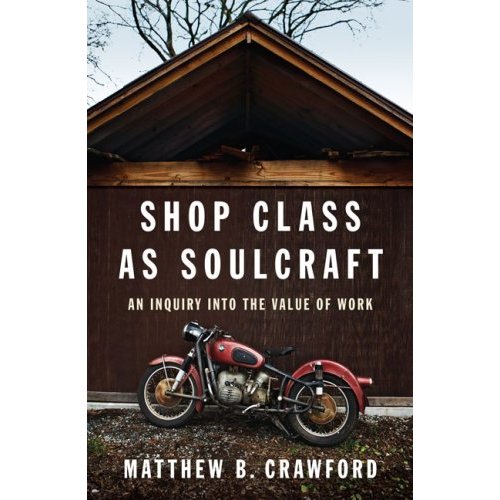
When I read “Shop Class As Soulcraft,” I initially felt like a twerp. I’m the guy who was raised in the country by a father who tried to teach him how to fix a car, repair plumbing, and so forth. I didn’t listen. Wasn’t interested. Couldn’t be bothered. “One of these days,” Daddy told me, “you’re going to be sorry when you end up having to pay another man to do what you ought to be able to do yourself.”
My father’s point, or so it seemed to me at the time, was that I would end up costing myself money that I might not have to spend. I couldn’t see it. I signed up for shop class at my small-town high school because it seemed like the thing to do, but it bored the daylights out of me. Besides, I thought, this isn’t useful for the kind of vocation and life I have planned for myself.
As it turned out, for most of my ca reer I’ve made more money than my father ever did, and it’s never been a hassle to pay for repairs (though my dad is the kind of man who would fix his own busted stuff even if he were a millionaire, as a matter of personal pride). In recent years, however, I’ve come to understand that what Daddy really meant was that I would feel less of a man if I outsourced out home repair to other men. I confess that I’ve come to understand in recent years what he meant. There’s nothing quite like the shroud of emasculating guilt that settles over me when a man who doesn’t have the education I have and haven’t read the books that I’ve read comes into my house and does things that I cannot do for myself. It doesn’t matter that I have the money to pay for this. As my old man would say, it’s the principle of the thing.
Nevertheless, you don’t see me picking up any do-it-yourself books these days. Home and auto repair seems so … alien to me. You might as well ask me to translate Serbo-Croatian verse. Look, I have a guilty conscience about this, but I know that if I tried to do anything more than the most basic job myself, I’d likely botch it, and not only have to call the repairman anyway, but=2 0also feel doubly like a schlemiel, having made the attempt and failed. OK, so I’m a neurotic about this stuff. I can read Matthew Crawford, and know in my bones that he’s right – but it hasn’t changed my behavior. It’s as if I’ve decided it was too late for me. Maybe it is too late for me. Or maybe that’s what I tell myself to avoid an unpleasant task.
And yet, as I was reading the book, unable to relate to Crawford’s love for mechanical things, it finally clicked that I have taught myself a useful skill, one that fulfills me in much the same way that Crawford’s motorcycle repair does him: cooking.
Neither my mother nor my father taught me to cook. I taught myself, in part because I got sick of eating out every night as a bachelor, but also because it interested me. I love to eat, and to eat well. I became enamored of how a kitchen alchemist uses genius, matter and heat to turn raw ingredients into what I consider to be high art. I dabbled in home cooking as a single man, and after I married, both my non-cook wife and I threw ourselves into it wholeheartedly. We read cooking magazines and cookbooks constantly. We shopped together for food, and cooked together too in our tiny Manhattan kitchen. We had some triumphs. We had more failures. In the years since, we’ve bettered our average.
Now, on the weekends, nothing gives me more pleasure than cooking. It’s not labor for me; it’s therapy. More to the Crawfordian point, making a gumbo, a pot roast or what have you gives me satisfaction that I simply cannot have from my fulltime writing. Writing is abstract; nothing is more real than dinner. I never know if my prose is any damn good, but there’s no denying that what comes out of my kitchen is first-rate. There is craftsmanship there, and by now, I’ve learned how to make some things without having to consult the cookbook. It has become second nature to me. At the risk of being too high and mighty, I’ve come to appreciate the sacramental nature of being a home cook, and mastering the craft of doing something hard to produce something worthwhile, that nourishes the body and, through the pleasure and conviviality it occasions, the soul.
I’ve come to see people who do not cook in the same way I suspect my father sees me with regard to my mechanical failures: as people who are missing out on something that makes them more fully human. Cooking – that is, making your own food (and even growing your own food; my wife has graduated to urban agrarianism) – is not easy, but it is rewarding beyond my ability to convey adequately. Yes, I have the money to buy pre-packaged and prepared food. But why would I? Yes, it’s easy. Yes, it’s convenient. But what do we miss by embracing comfort and ease uncritically?
In Aldous Huxley’s “Brave New World” – read Mark Shiffman’s thoughts on the book’s twin Gnosticisms here — the people have surrendered their liberty and their personal autonomy to a state that has convinced them they should never want for anything, or perform any kind of labor they’d rather not do. In the penultimate chapter, an outsider called The Savage confronts one of the World Controllers, tel ling him that in engineering a world in which nobody can do anything for themselves, or aspires to, he and his cohorts have created a comfortable, leisurely, anti-human hell.
When the World Controller tells the Savage that the authorities have eliminated mosquitoes, the Savage, whose moral education came from reading an old collection of the (now-banned) plays of William Shakepseare, reacts:
“The Savage nodded, frowning. ‘You got rid of them. yes, that’s just like you. Getting rid of everything unpleasant instead of learning to put up with it. Whether ’tis better in the mind to suffer the slings and arrows of outrageous fortune, or to take arms against a sea of troubles and by opposing end them … But you don’t do either. Neither suffer nor oppose. You just abolish the slings and arrows. It’s too easy. … ‘What you need,’ the Savage went on, “is something with tears for a change. Nothing costs enough here.'”
Nothing costs enough, and everything is too easy. What the people in the Brave New World needed to regain their full humanity was to do hard things. Which, if you think about it, is pretty much what Matthew Crawford is saying to us all. The grease on my hands is more likely to be extra-virgin olive oil or bacon drippings than the black stuff under Crawford’s fingernails, but I think I understand what he means.


[…] Posts: ”Gumbo as Soul Craft” by Rod […]
I think that Crawford does not have disrespect for the individual whose talents and passions are not of the crafting variety. The author rather demands respect for the talents and brain power of those who are gifted that way. Society has become enamored of those who work in 3 piece suits with perfect manicures, as if they are the salvation of the world, and disdainful of those who keep the world running and fed. We need both, with respect for each others talents, art and abilities.
Comments are closed.