


“Put It in Your Own Backyard.” Jeffrey Polet doesn’t want a data center in his backyard: “I take offense at people who care about their town, the ones who pay the price for someone else’s ‘progress’ and pocketbook, being disparaged as ‘snobs.’ Nor will I countenance the idea that distant and often anonymous powers or ‘invisible hands’ should override the will of the people who occupy those places. Legislatures so empowering developers are abandoning rather than exercising representative government.” It is perhaps worth nothing that chunks of Michael Munger’s essay, to which Jeff is responding, are AI-generated. I suppose it’s fitting to let machines make the case for machines to run roughshod over places where humans and other creatures dwell.
“Annie Dillard, Pittsburgh-born Pulitzer Prize-winning Author, Dies at 81.” Sono Motoyama remembers Annie Dillard, who was, among many other things, a brilliant crafter of sentences: “Dillard was best known for Pilgrim at Tinker Creek, her 1974 meditation on nature, faith, beauty and cruelty, written while she was still in her 20s. The book won the Pulitzer Prize for general nonfiction the following year. It was compared to the work of Henry David Thoreau, whom she had studied in graduate school.”
“A Friend for Life.” Peter Mommsen introduces what, at least from what I’ve read of it thus far, is another excellent issue of Plough by bearing witness to an unlikely and moving friendship: “Truth-telling went both ways. Lee didn’t hesitate to take my dad to task if he disagreed with his decisions about us kids or disapproved of this or that new Bruderhof venture. My dad, for his part, was often kept busy helping Lee keep his rough edges socially tolerable. There were periods of estrangement, yet each time the underlying loyalty won out. Both were committed to the core habits of friendship: going out of one’s way for the other, taking risks for the other, and, at least weekly but usually more often, spending time together.”
“A Picture of a Good Death.” In that issue, Shana Goodwin reviews Joseph Orso’s book: “Death is a communal process here, and I was moved to read in Orso’s account the possibility of an individual family echoing the same attitude with the support of neighbors and friends. The book highlights the practical services that made the home burial possible: plowing snow, making food and phone calls, sitting vigil.”
“The Sacred and the Secular in West Texas.” Nick Ripatrazone reviews Christian Wiman’s new book The Dance and ponders the power of language: “What does poetry do to language? The answer depends on the poet, and the poem, but one would hope that poetry refreshes language, sharpens it, while recognizing that language is a tenuous exercise in signs and sometimes wonders. Wiman’s finest poems are often his leanest — short, under a dozen lines — or those whose lines carry only a few words each. His poems in that mode aren’t as columnar as the work of Kay Ryan, but they unfold just as quickly.”
“The Original Sin of AI.” Sherry Turkle insists that AI should be regulated to prevent machines from posing as persons: “The original sin of AI is granting chatbots the use of the first person. Given that these products are designed to deceive users into believing that they are talking to a wise and compassionate being, the job before lawmakers is to make it plain—especially to juveniles—that there is, in fact, nobody home.”
“A Wendell Berry Challenge.” Plough is inviting readers to live out Berry’s vision in their own places: “In Berry’s honor, we’d like to invite you to plan and carry out some sort of local community-building event with your immediate neighbors in the next few weeks, and then let us know how it went. What could that look like? Really, anything that serves to bring people together for camaraderie or service or feeding of the mind, body, or soul.”
“Great Books and the Good Life.” Doug Sikkema ponders human nature in the company of The Odyssey and other great books that probe “the perennial tension humans have always felt between our seemingly insatiable appetites—for food and drink, sex and fellowship, shelter and protection—and our abiding happiness. The ancients examined how these very human needs and desires might be restrained or liberated, directed or inhibited, snuffed out or kindled in order to bring peace and order and rest to the body and the body politic. “
“The Sword of Damocles Life.” David Mills tries to describe what life is like in a marriage with a cancer diagnosis: “I started calling life with a terminal cancer patient ‘the Sword of Damocles Life.’ Something happens and you think it’s the end, but it’s not. There will come a time when it is. But until then, it isn’t.”
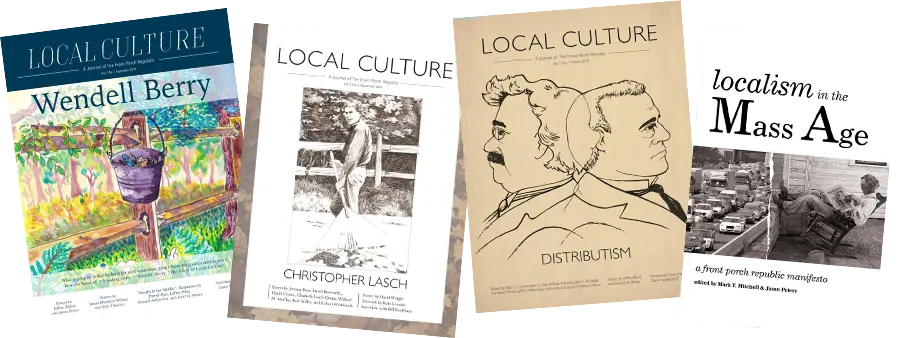
“My Dumbphone Made My Life Better. It Made Everyone Else’s Worse.” Stephanie H. Murray gives a very accurate description of what it’s like for dumbphone owners to navigate a world made for smartphones. I articulated how I approach about these trade-offs in an essay I wrote for an issue of Local Culture a few years ago. Here’s Murray’s statement of the problem: “I anticipated that not having a smartphone would make me more reliant on other people — perhaps without Google Maps on hand, I’d have to ask an actual human for directions. And sure, that’s happened. But I think it’s more accurate to say that I’ve become more reliant on other people’s smartphones. Instead of ordering from the bar or printing out movie tickets ahead of time, I inevitably wind up having somebody else scan the QR code menu or pull up the e-tickets. It’s still smartphones all the way down; I’ve just exempted myself from the costs of carrying one around.”



2 comments
Andre
“I articulated how I approach about these trade-offs in an essay I wrote for an issue of Local Culture a few years ago.” Could you share a link?
Jeffrey Bilbro
Well, it doesn’t exist online. It was in issue 4.1: https://www.frontporchrepublic.com/local-culture-archives/