I moved from Alabama to Kentucky in January 1997. Nearly four years later in December 2000, I embarked on an even greater adventure, though I didn’t know it at the moment. For the first time since I started kindergarten in Tell City, Indiana, I was preparing to spend several months not enrolled in an educational institution. In fact, I was still waiting to discover where I would pursue my Ph.D. the next fall. Neither the time not in school nor the waiting to hear from graduate programs, however, proved the real adventure. Instead, listening to the advice of two trusted friends set me on a path of learning and exploration. The advice Paul House and Sean Lucas offered me? Take this time between graduate programs and read some things. More specifically, they encouraged me to read some of the fiction of a Kentucky author I had really only heard of because Sean had mentioned him on several occasions. That author? Wendell Berry.
Now, I ought to reveal here that fiction was not a genre I had really spent all that much time reading up to that point in my life. Yes, I read the required texts from my literature classes at Tanner High School and the University of Mobile. But outside of those limited forays, I didn’t turn to fiction as a matter of course. I would have likely argued that my time was better served and my intellect was better challenged by reading works of nonfiction, especially history or philosophy or theology. But I valued the opinions and guidance of Paul and Sean. So, as the holiday season of 2000 approached, I worked out a plan. It wasn’t a complicated plan. I didn’t ask people what short story or novel was the best or their favorite. I didn’t scour Amazon for reviews. As I said, my plan wasn’t complicated. I was simply going to tackle Berry’s novels and stories in the order of their publication until I got bored. I figured that was straightforward enough. Thus, I opened up Nathan Coulter and began reading the stories of the Port William Membership.
Over the next two months or so, I devoured all the stories then available. I didn’t get bored. In fact, I remember sitting with family over Christmas reading The Memory of Old Jack through tears. By the end of February 2001, I had finished Jayber Crow and devoted myself more entirely to worrying about which graduate programs (if any) were going to give me a chance. By the end of the spring, I had not only heard from and visited some schools, but I also had decided that I would start doctoral work at the University of Kentucky in August. My study of the intersections of race and religion in colonial New England occupied most of my time until I finished my Ph.D. in early American history in 2006. That said, I do remember expectantly reading copies of That Distant Land, Hannah Coulter, and Andy Catlett during those years. I saw those excursions primarily as distractions, not realizing that my education with and from Wendell Berry was far from over.
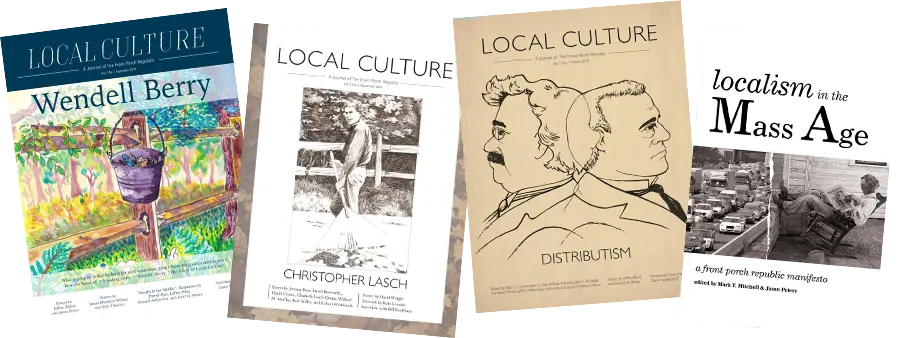
In fact, a few years later, Wendell Berry—the actual man—stepped in and began adding his own instruction alongside the words of his I was regularly reading. Before that occurred, though, I started reading his essays shortly after taking my first tenure-track teaching position in Buffalo, New York. I nearly immediately found the same captivating prose and language. Berry’s essays challenged me in ways I never expected. Then, a year or so later, I started reading his poetry. Again, the beauty of the language overwhelmed me, introducing me to a genre that I wasn’t really certain how to interpret. Shortly after diving into his poetry, I reached out to Wendell to see if myself and two friends, Paul House and Ben Mitchell, could meet with him to discuss the theme of friendship in his various writings. He agreed, and we enthusiastically made our way to Port Royal in November 2012. From that initial visit where we discussed friendship and Berry’s use of the phrase “beloved community,” I began searching for more ways to wrestle with his ideas and to learn from him. Very graciously, he allowed me to do both—to wrestle and to learn. And he allowed me to do so both in correspondence and around his kitchen table. Distance and duties often hindered such lessons from happening as much as I would have liked. Nonetheless, though, Wendell instructed me. Sometimes by his words—spoken and written. Sometimes by pointing me toward others’ words—books he had read or was reading (such as John Lukacs, Elizabeth Marshall Thomas, and Pete Daniel) and people whose voices he respected and cherished (such as Ed McClanahan, Gurney Norman, Bobbie Ann Mason, and Brooks Lamb). And my life is so much the better for these connections, many of which prompted other connections and friendships that led to continued learning.
When Silas House, a friend I met in part through this chain of connections Wendell helped foster, shared the news of Wendell’s passing with me, I immediately began considering some of the specific ways this monumental man changed my life over the last nearly three decades. I know that a list of such lessons will go on and on, and I look forward to it doing so. But, in light of the opportunity I have been offered here, I want briefly to share some of the initial things showing up on said list as I reflect on the life and work of Wendell Berry.
The Power of the Particular
In his 1991 essay “Out of Your Car, Off Your Horse,” Berry asserted that “Abstraction is the enemy wherever it is found.” After reading this claim, I began to see the same idea in his essays beginning as early as the 1960s with some of those located in The Long-Legged House. From “Think Little” on to The Need to Be Whole, Berry stresses the power of the particular. Knowing a thing is pretty essential to caring about that thing. Or at least in deciding whether you care about that thing. A particular thing can be known and loved or not. An abstract thing cannot. In fact, abstractions of things, Berry argued, allow us to abuse the people and the world around us. By focusing on the local and on the specific, we at least conquer some of those inclinations toward abuse. Or ought to. I seek to remember this lesson in everything that I do. From how I relate to my friends and family to how I treat the sources about which I am writing as a historian to how I engage the staff at my local restaurant or bar. I am grateful for this particular lesson.
The Virtue of Hope
Another lesson I learned from Wendell is about the necessity of hope. Even after grasping his distinction between hope and optimism (and why he preferred the former), I remember using the word “optimistic” to describe myself to him on one occasion when he found Paul and I on a road near his house a few minutes before we were scheduled to stop by and spend some time with him and Tanya. As soon as I said it and he made a reply about hope, I winced. And then I starting looking for his use of the word “hope.” From as early as the essays in The Long-Legged House, Wendell consistently argued for the necessity of hope. Through his fiction, nonfiction, and poetry, then, he encouraged me to wrestle with developing a sense of hope, and to look for ways to practice hope, even when circumstances might seem less than hopeful. Being hope-filled in such moments is crucial. I am grateful for the hope of this particular lesson.
The Discipline of Peaceableness
Wendell also pretty radically helped me to rethink how I want to relate to the notion of peace. It’s one thing to proclaim “Peace be with you,” but it’s an entirely different thing to live a life of peace. A life that offers peace to everyone around you, including those with whom you share sincere and serious disagreements, doesn’t simply happen. Such a life requires discipline. Wendell regularly treated peace and peaceableness as a discipline by which we can offer hope for and to the world. Through his writings, he taught me to express the same hope and trepidation of being “devotedly enough a pacifist.” I am grateful for this particular lesson and the peace I hope it helps me pursue with those around me.
The Matter of Friends and Neighbors
When Paul, Ben, and I first went to visit with Wendell in 2012, we went to discuss the idea of friendship. Listening back to some of the audio from that meeting, I recall our lively conversation about community, friends, and neighbors. From African bushmen to biblical injunctions from Job and Paul and Jesus to intentional communities to neighbors sharing work, our conversation ranged widely. We shared laughs and asked each other probing questions as we considered the matter of friendship and what it meant to be a friend and neighbor. We discussed Wendell’s regular and provoking idea of friendship as a “long conversation.”
Following that Sunday afternoon, the three of us who traveled together to Port Royal added to our already lengthening conversation. Following that Sunday afternoon, I began a conversation with Wendell that occurred in letters and in person. He shared stories and songs and jokes. He responded to my questions and even asked questions of his own. He shared concerns and prayers about my family and my job. Following that Sunday afternoon, I also began to see the beginning of other conversations. Some of those conversations continue. Some of them have ended or at least they’ve become a little more one-sided as participants have passed. I mean, I still talk with Gurney and Ed and learn from their writings. I feel certain my conversation with Wendell will continue, as well. I know I will continue to learn from his words. I am “grateful,” like Elton Penn and Henry Catlett in Remembering, “to be in the same story” and for the particular ways he made certain I realized that friendship matters.
I believe we have lost one of our nation’s significant voices. I know quite a few of us feel the same way. I am encouraged by the fact that his daughter Mary Berry, who founded and directs The Berry Center in New Castle, Kentucky, will continue to voice many of the concerns of her father, her uncle, and her grandfather and will speak to many of the issues they addressed. I am grateful Wendell left us so many works to visit and revisit. In the end, as I reflect on his passing, I do so with a particular hope for the peace that Wendell Berry’s legacy and life offer each of us as we strive to be the friends and neighbors this unsettled world demands.