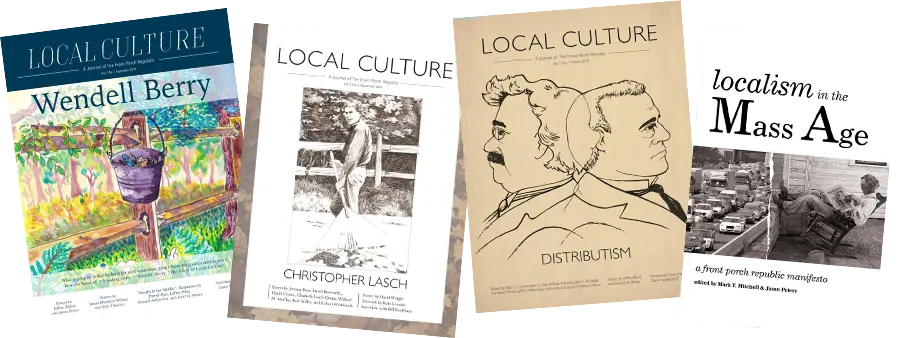

“The Challenge of Wendell Berry: A Personal Assessment.” Brian Volck ponders what he learned from Berry as a writer and a friend: “How fitting that my first memory of Wendell Berry was of him laughing. For all his erudition, industry, and grave concern for the fate of the land and its creatures, I remember him as a man who loved a good laugh, an engaging story, a well-told joke.”
“Anarchist Notebook.” Alan Jacobs outlines a very Porchy politics: “I am temperamentally and morally a conservative, which is to say: I believe that I am charged with preserving my inheritance, nurturing it, and passing it along to the next generation. That inheritance is spiritual, cultural, natural, and political. (It may or may not be financial; that matters little.) Our largest social problems stem from the fact that our political economy promotes the concentration of power and money, and the concentration of power and money militates against the preservation of any spiritual, cultural, and natural inheritance. That is how we get an unprecedentedly rich and theoretically free society that also features corrupt religious institutions, insipid art, and dying rivers. I will continue to do my best to conserve and promote my Christian faith, my convictions about art, and my natural environment, but I must do so in unpropitious conditions. We need an alternative political economy that encourages rather than inhibiting the work of conservation, and I think anarchism, properly understand, is that alternative.”
“Are We Really on the Path to AGI?” Yuval Levin has a very levelheaded and, I think, accurate assessment of how AI is developing and improving and what this means for the future: “It would not be unfair to say that large-language-model AI is now (and will increasingly be) a coding engine that, on the side, also utterly transforms every realm of human life. Most of the transformation of the rest of the world is a function of the spread of unscripted computing achieved in the absorptive-learning phase of this technology.”
“Maxxing Treats Life as a Problem When it’s a Mystery.” Håkon Evjemo warns that the pursuit of even good goals can foster a false view of life itself: “Eating well, exercising regularly, learning new skills – these are cornerstones of many self-improvement regimes. Who would not welcome a bit of science to shed more light on how these work? This is precisely what books like Why We Sleep – as well as Atomic Habits (2018) by James Clear, Mind Your Gut (2024) by Kate Scarlata and Megan Riehl, and The Brain that Changes Itself (2007) by Norman Doidge – intend. And yet, working my way through these books I could not help but notice something more nefarious at play. This new toolkit of science-backed interventions seemed to grow into something greater than the sum of their parts. The question of the good life was devolving into a far less ambitious task: the solved life.” (Recommended by Dominic Garzonio.)
“Character.ai’s Bankruptcy Documents Show the Economics of AI Don’t Work.” Jason Koebler reports on an AI bankruptcy. If companies like Anthropic can convince businesses its models can produce code more cheaply than people can, they may be able to become profitable, but it’s at least good to see that artificial “friendship” is a losing proposition: “Character.ai’s bankruptcy is the one of the first dominos to fall in the long-foreseen AI bubble. The circumstances of its bankruptcy are exactly what critics of AI have been saying would happen: Character.ai lit a huge amount of money on fire running its product, did not bring in a lot of revenue, and faced enormous legal fees after causing harm to its users. Enshittifying its product to try to make its expenses cheaper did not work, according to a narrative filed in bankruptcy court Tuesday.”
“The Great Data-Center Rebellion.” George Packer reports from one city in Iowa that is trying to resist a hyper-scale data center: “I found the proceedings both mind-numbing and inspiring. The seriousness of purpose, the attention to detail, the stamina required to talk and listen—all of it moved me more than it seemed to impress anyone involved. Clintonians Against Data Centers still felt patronized and ignored. Perhaps the council came away exasperated with the NIMBYs and gadflies who were making the process such an ordeal. (Later, the mayor admitted to me, “We’re learning that there’s probably more ways that we can communicate with the citizens.”) In all likelihood, this small populist uprising will not achieve its goal; a hyperscale data center will come to Clinton, Iowa, amid widespread unhappiness and damaged friendships; and AI will continue to roll over the fields of the republic. But a democratic pulse was still beating along the Mississippi River. That was something.”
“Standing by Words.” Orange Blossom Ordinary is hosting a discussion of one of Wendell Berry’s seminal books this weekend.
“A Farmer’s Alphabet.” Brian Miller needs an illustrator to turn his alphabet into a book: “K is for Kraut: Kraut, kimchi or kraut-chi: That simple alchemy of veggies and sea salt yields delicious and shelf stable nutritious food in a few short days, championed by Misters Price, Katz and Vaughn. Made from whatever is in season but always benefitting from the crunch of cabbage. Chop your veggies, mix with salt and stuff into a jar and you are off.”
“In Grief, a Mother Asks Strangers to ‘Sit Here’ at a Ballgame.” Tim Arango describes how one woman cultivated community and healing through attending baseball games: “A. Bartlett Giamatti, a literary scholar who served as commissioner of Major League Baseball for five months until he died suddenly in 1989, famously wrote that baseball is ‘designed to break your heart,’ because it ‘leaves you to face the fall all alone.’ Yet this season, Ms. Strub, 71, found that the opposite was also true: Baseball can help heal a broken heart.”