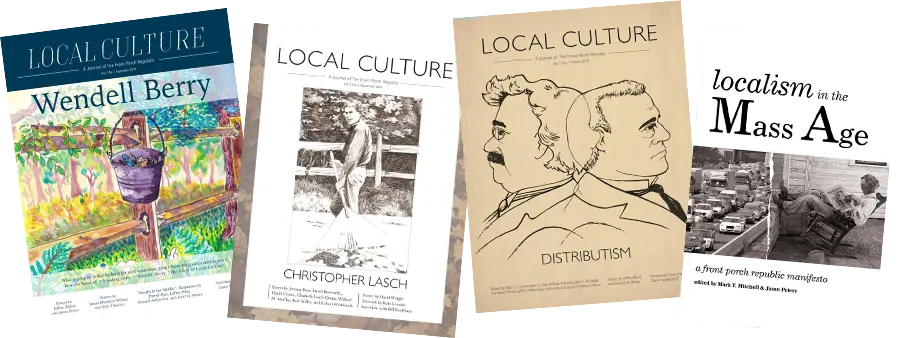

“Explaining Wendell Berry.” Doug Sikkema describes how he learned to read—and live out—the wisdom of Jayber Crow: “Perhaps that was what was behind Berry’s challenging, enigmatic, cantankerous warning. Don’t think you understand my book, Doug, because you can talk about it in the foreign tongue of academia. You understand a book when you learn to stand under it—or, better, to stand by it. Far from our old homes, from our pastors and parents and friends, my wife and I received Berry’s writing—more of which I would devour in the course of that year—as a providential epistle to us, a young couple learning how to depend on each other in a strange place, moving forward into the unknown future, discerning the longer arc of our shared lives and where and how we would make a home in this world.”
“At the Center of Things in Newton, Kansas.” Jeff Reimer’s account of life in Newton, KS, which I had the privilege of visiting this summer, opens with some advice about what to do if you encounter a train coming through town: “The train will likely have more than 100 cars and be over a mile long. Sometimes it will slow down and stop, reverse course, and go back the direction it came from. And sometimes the train, for reasons unknown to all but God, will just stop. It will sit right there at the intersection, the crossing lights flashing, the bells ringing, the arms down, and everybody in their cars sighing and groaning. You will likely recall that at Newton’s 150th anniversary celebration, they sold shirts that said, ‘Waiting on trains since 1872.’ Your other option is to try to beat the train.”
“Why Do You Hate the South?” Alan Jacobs writes about his complicated relationship with the South: “The food, the music, the vast pine forests, the big slow rivers, the long low ridges that divide the valleys there at the Southern terminus of the Appalachians — this is the South of my dreams and my imagination. All these have marked me deeply and continue to nourish me. But my primary loyalties, I find now, as my seventh decade nears its end, are with the Republic of Letters and, above all, with my fellow Christians wherever they are found. I am grateful for so much of my Alabama upbringing, but my mind is usually elsewhere, and that too is something I am neither proud nor ashamed of.”
“Cosmic Anger.” The most recent issue of The Lamp is online, and it’s got some excellent essays. Take this one from A.E. Stallings on wrath as it threads through Homer, Virgil, and contemporary life: “Wrath is one of those engines by which evil is done—wrath is, I would argue, more than hate, the opposite of love. If one can define by opposites, is not wrath precisely the opposite of Paul’s famous definition of love in his first epistle to the Corinthians? . . . . Hatred, one might say, has at least a focus on the other, however twisted; but wrath’s deadly focus is on the self, a kind of weaponized self-pity.”
“The Last Whole Earth Agrarian.” Alan Cornett reflects on Wendell Berry’s life and influence: “In a world of AI, lab-grown meat, life in the pod, and a growing push for space colonization, Berry foresaw that perhaps the important delineation would not necessarily rest with Right and Left. He wrote in his book Life Is a Miracle, ‘It is easy for me to imagine that the next great division of the world will be between people who wish to live as creatures and people who wish to live as machines.’ For Berry, we needed to embrace the gift and freedom to live as God’s creation.”
“Remembering Wendell Berry.” Brian Miller considers Berry from the context of his own place and farm: “A small farm cannot completely escape the market. As a wise Kentucky elder once said, make sure you get in the habit of selling something every week. For all the joy and pleasure that we get from living on this land, it takes work and a continued focus to build and sustain an income stream. That is not, or shouldn’t be, a contradiction to being a good steward to the land and a good husband to the livestock.”
“Last Night, College Athletes Lost.” Joe Nocera isn’t impressed by the bill the Senate passed to address the mess that is division 1 college sports. It’s long past time to jettison the educational arm of the multiversity and let the medical complexes and sports industry and real estate investments do their thing while the work of education happens somewhere else: “Nobody put a gun to Ohio State athletic director Ross Bjork’s head and forced him to pay his star wide receiver $5 million. Nobody forced Northwestern University to raise $875 million to build its new football stadium (which will open this Saturday). And certainly, nobody forced LSU’s president Wade Rousse to give the university’s new football coach, Lane Kiffin, a seven-year, $91 million contract and pay the coach it fired, Brian Kelly, a $54 million buyout—even as Rousse was complaining that ‘we’ve got to stop the bleeding.’ That’s what I mean when I say that the college sports pooh-bahs wanted Congress to save them from themselves.”
“Inside the Biggest Feud in Artificial Intelligence.” In this excerpt from his new book, Kevin Roose describes Anthropic’s messy split from OpenAI and the personal feud at the core of the AGI race: “Despite the companies’ recent willingness to cooperate on safety measures, few people who know Altman, Brockman, and the Amodeis expect them to make amends anytime soon. Workers at both companies have noted the irony that although their bosses train AI models to be kind and compassionate, they can’t stop trashing one another. For now, it seems, the ‘machines of loving grace’ will be built by humans of bitter spite.”
“Religious Scholars Met With Anthropic. What They Heard Stunned Them.” Elizabeth Dias details Anthropic’s efforts to convince people that Claude might be conscious: “A key part of the presentation, participants said, was what Anthropic called the model’s ‘persona selection,’ about how to get Claude to see itself as a virtuous actor. The company argued that how people treated Claude could affect how Claude treated people. ‘They really made a strong case,’ said Andy Crouch, an evangelical author and partner at Praxis, a network of Christian entrepreneurs. ‘We’ve got to treat it like a person if we want it to interact with people in a morally consistent way and for it to make the best moral and emotional judgments.’” Well, no, we do not have to treat machines as if they are persons.
“The Humanism Driving the Anti-A.I. Movement.” Becca Rothfeld reports on the recent Pro-Human Assembly: “Perhaps it’s unsurprising that some of the richest critiques of A.I. have come from artists and religious leaders, both types whose professions oblige them to become comfortable with the sort of philosophical language that the political establishment tends to avoid. Many of the people I called were interested in what a flourishing human life looks like, and in how A.I. alters the texture of daily experience.”
“AI Promises Intimacy but Delivers Isolation.” Keith Plummer reviews Sherry Turkle’s new book: “Tech companies producing AI chatbots want to maximize user engagement with their products. Making them as humanlike as possible is one of the most effective means of accomplishing that end. A program that refers to itself with pronouns like ‘I,’ ‘my,’ and ‘mine’ is deceptive. Turkle calls such anthropomorphizing ‘the original sin of artificial intimacy.’”
“Cormac McCarthy’s Desert Wanderings.” Michael Crews reviews the first biography of Cormac McCarthy: “Daugherty is attuned to the role of places in McCarthy’s life. In one particularly lyrical observation, he writes, ‘McCarthy knew that in legends and myths the desert is the site of temptation, sometimes a place of redemption, and certainly a place of death for those who come to it unprepared. A place for exiles and solitaries seeking enlightenment.’ Early in the book, Daugherty correctly notes McCarthy’s love for Thomas Merton’s The Wisdom of the Desert, a collection of sayings from the fourth-century Desert Fathers. The book extols the wisdom of a life in which the pregnant silence of spiritual contemplation is cultivated, a silence that is the fruit of a mystical encounter with God. McCarthy’s papers, housed in The Wittliff Collection at Texas State University, contain several references to Merton, and the book itself, now part of the McCarthy archive, is full of McCarthy’s marginal highlights.”