We the people used to throw a mean party—but then we stopped. So journalist Derek Thompson reflected recently, with charts and numbers to show the steady downward national spiral. Specifically, “Until 1975, half of Americans said they entertained guests at their home every month.” It’s been downhill ever since. The 1980s were not a convivial decade, and the 1990s were even less so. The early 2020s, with the Covid shutdown and its aftermath, only further encouraged isolation, promoting “social distancing” as key to literal survival. And now, here we are, eating our sad meals alone—probably while doomscrolling.
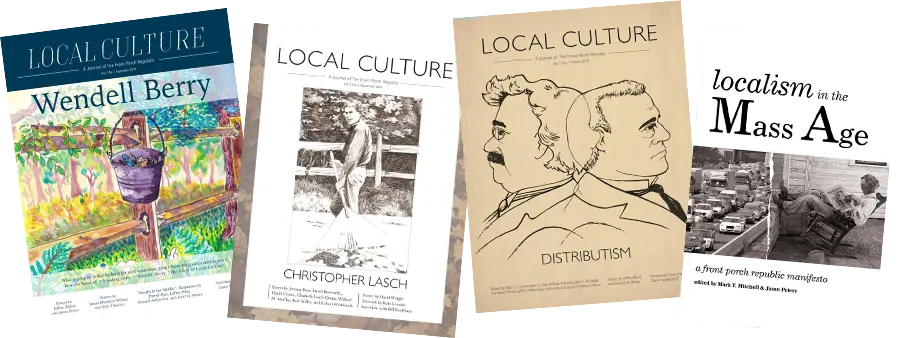
Front Porch Republic, which began publishing essays in March 2009, and has held an annual conference every fall since 2011 (with a Covid interruption), is about much more than simply bringing people together for convivial purposes, including delightful meals and conversations together. But it is certainly about no less than that. In the process, FPR pushes back on civilizational trends like those Thompson bemoans, not merely by arguing against their damaging effects on our bodies, minds, and souls, but by showing the beauty of the alternative in action. What does it even look like to gather with others? And why are such gatherings both a public good and a personal one—promoting the flourishing of our society at large and the flourishing of individuals?
Perhaps the answer is simple—but it is no less worth repeating for that simplicity. As Wendell Berry, the patron saint of FPR, has shown in just about every poem, novel, and essay he wrote, people are made for relationships. People are made for membership in their local community—the place where they can and should put down roots. Fostering a love for the places where we live and the flourishing of our neighbors there is integral to the mission of FPR. And as statistics about our very isolated and lonely society remind us, it’s a mission that only grows more countercultural each year. Forget trying to love thy neighbor as yourself. Too many of us do not know our neighbors’ names. Worse yet, we might not even recognize them in a lineup or when we pass them on the street.
I had occasion to reflect on this fragmented nature of modern neighborhoods while attending my first ever FPR conference, held last weekend in Indianapolis, and thus an easy drive from my Ohio home. It turns out, we the people really can still gather for good intellectual conversations. Furthermore, nothing in our very online world can replace such gatherings, even as written words have their beautiful purposes too.
While I have been writing for FPR since 2022, this was the first time I was able to attend the conference—and it was a delight to meet so many people whom I’ve previously only known through their words. Our conversations, I realized, were so much richer than is normally the case when meeting someone in person for the first time—precisely because we have been reading each other’s ideas for so long. Written words cannot replace in-person connections, but they can make them richer sometimes. All the coffee and donuts and sandwiches eaten while talking together didn’t hurt either.
I brought my two younger kids with me. On the way home, my seven-year-old piped up, reflecting on the conference theme of “Neighborly Arts”: “I love my neighbors. They are the best.” Yes, the conference presentations repeatedly reflected, life is better when lived joyfully and deliberately together with other people—family, friends, neighbors, and community. But what might this life look like in action? That was the question for the day, and the answers went in directions both predictable and less so. It can look like caring for the neighborhood buildings and infrastructure, argued Joanna Taft, who introduced herself as “just a neighbor.” She also showed off pictures of her very impressive porch, suitable for hosting dinners and gatherings year-round, with blankets to ward off the freezing cold when needed. It can look like hosting the entire conference at one’s home for a reception afterwards, showed another speaker, Alexandra Hudson (alas, I had to skip the reception and hit the road to get home that night). And in this contentious and politically divided age, it can look like entering state politics, Robb Greene and Hunter Smith suggested in their presentations, drawing on their personal experiences of combining a life of farming with serving in Indiana state politics.
And it can look like stewarding intellectual communities like FPR, Patrick Deneen reflected in his keynote address, a retrospective on the story of the journal and its conference. Building intellectual institutions is analogous to building physical neighborhoods. Both require significant effort, years of investment, and at times even sacrifice from those who care for them most. And both require relationships with real people. FPR has been blessed with a good contingent of writers who have been invested in the project since the beginning, I realized this weekend, as I was listening to their stories. And the more recent generation of writers for the site has provided a similar network of like-minded intellectual neighbors for each other as well.
But for my kids, as we were debriefing on the way home, a life filled with neighborly arts came down to our habit of regularly inviting friends to our home for lunch and dinner and (both kids emphasized) making macaroni and cheese for the guests. From scratch, of course—never from a box or from the freezer. (I’m afraid we would be terrible hosts for the lactose intolerant.)
“Did we need to drive four hours away from home to think about how much we love our neighborhood?” my contrarian eleven-year-old jokingly asked in the car. He thoroughly enjoyed the weekend, to be clear, and made friends with another boy around his age, and even sat together with this new friend at the final session of the conference. But perhaps the answer to his question is a resounding affirmative. Yes, we knew before that we love our neighborhood and are grateful for our neighbors. But the weekend gave us further language for articulating this love, and why it is a well-ordered love that is worth pursuing and cultivating.
As I am writing this, it is late evening, and our neighborhood is blissfully asleep. But tomorrow afternoon, when our public-schooled neighbors get home, I look forward to my doorbell ringing, as the kids from our street gather together to play, practicing the neighborly art that comes so naturally to them without anyone teaching it: joyful friendship.