


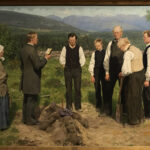
A man lies on his daughter’s grave. She was two years old when the Black Death took her. He weeps that she now rots under this little hill. A precious pearl slips from his hands through the grass to the mound of earth. He is trapped, he says, in a “dungeon of sorrow.”
The fragrance of high August flowers causes him to doze. Suddenly he is separated from his body. He sees himself lying on his little girl’s resting place as his spirit is whisked away to a distant land of startling beauty.
There he discovers a river and across it, a young woman. He knows her at once.
  The beauty of these downs and dales,
  woods, water, plains! My heart eases,
  enriched. The light of hills dispels
  my hurt, drives away these dark griefs.
  I am alive, mind brimming, heart full
  as I stroll beside swift-running water.
  Down thru the valley I wander, I wonder
  that my spirit strengthens in each step.
  Fickle Fortune, you smile, you frown,
  you test us on a whim, solace or harm;
  joy today, perhaps, sorrow tomorrow,
  you give us plenty, more and more.

  Words escape me. Just being here
  is a joy beyond what human heart
  may endure, what mind can grasp,
  what mortal words might explain.
  This is Paradise, I think, what
  else could these bright banks be?
  The water is a border, a divide
  between perfect and perfection.
  Surely across the water there lies
  a heavenly city, high on a hill.
  But I dare not brave the deep
  water I long for, more and more.

  More and more, and all the more,
  I long to see the meadow beyond,
  for if this land is a wonder, how
  much more seems the distant shore.
  I stop, stare about me, eager to
  find a crossing; joy is near,
  but with each step along the bank,
  I find dangers great, only fear.
  “But it’s peaceful,” I say aloud,
  “Don’t wait, it’s so lovely here.”
  Then it happens, unexpected, a
  surprise, moving me more and more.

  More marvelous yet beyond the
  water, running fast, just past
  the farther side rises crystal
  a cliff, reflected rays. At its
  foot, a young girl in white,
  gracious, mild, dazzling, pure.
  I know her, I’ve seen her before.
  She is known to me, this child
  now grown, she sits, shines as
  gold glistens when first cut:
  I look, I linger longer still,
  I know it’s her, more and more.

  The more I look on her face,
  her outline just so, I am
  overwhelmed, stunned, glad
  to see her as never before.
  But as love makes me cry out,
  so grief silences my soul.
  Then she turns to the light,
  sees me, eyes warm, a gentle
  nod, her head tilted just so,
  face white, pure as before;
  I cannot think, I only stare
  ever the longer, more and more.
The father’s vision continues. His daughter, named Pearl, whom he calls his pearl of great price, lives with God. She is beloved and stranger, child and teacher, simultaneously all that she once was and now all that she is in death and union with Christ.
How can this be? her heartbroken father wonders. How does a small child end up in heaven? They talk it over, father and daughter. And oh, what they discuss!
He keeps asking questions, as much to continue talking with his daughter as to learn. Finally he can stand it no longer and attempts to jump into the river to be with her.
Christ stops him. No, not now, not yet.
The Dreamer wakes. He is riddled with guilt, not for attempting to cross to the other side, but for upsetting the vision of his daughter too soon. He would have stayed if he could.
But that, too, was not time.
And so he ends where he began. He still misses his daughter. He still loves her. He still wonders if his vision was a reality or mere desperation. But now there is one crucial difference.
Hope has replaced despair. He will see her again.
The Pearl Poet
The British Library holds a manuscript labeled Cotton Nero A x. It contains four narrative poems from England’s northwest midlands written in the late fourteenth century. The last of these, Sir Gawain and the Green Knight, is considered a masterpiece of the age. Its Arthurian roots have placed that verse in the public consciousness, not least for being translated by J. R. R. Tolkien.
The first poem in the Cotton Nero manuscript is Pearl. Its anonymous author is considered one of the finest poets of the Middle Ages, the time of Chaucer, Petrarch, and Dante. Pearl is a classic elegy, admired by scholars and specialists for centuries. But it has fallen by the wayside.
Tolkien also translated Pearl. In verse that he says is greater than Chaucer’s, the Dreamer’s poem is “founded on a real sorrow . . . real bitterness.” It is precisely the depth of grief felt by a parent for a child. Indeed, the piece is wholly designed for our sympathy to go out to the father. Such visions were popular at the time, Tolkien explains, because as autobiographical pieces they “allowed marvels to be placed within the real world, linking them with a person, a place, a time.” He adds that this is the most likely explanation for the poem’s personal tone, poetic quality, deep feeling, and sense of urgency. It represents those long struggles of grief that are just as real as the first waves of bereavement. “The final consolation of the father was not to be found in the recovery of a beloved daughter, as if death had not after all occurred or had no significance,” Tolkien concludes, “but in the knowledge that she was redeemed.”
Poet Bernard O’Donoghue agrees. An expert in Medieval English with Wadham College, Oxford, he praises Pearl’s stylistic power and imagination, but he is also moved that “it does not cancel the deeply mourning sentiments that the consolation addresses.” As a consolatio, Pearl may offer hope to the Dreamer as he comes to realize that his daughter lives on with God, but he is never reconciled. He still feels “love’s deep harm.” When the poet wakes, he remains on the mound of his daughter’s grave, her death a cruel reality. And yet his vision lingers. “It is hard to describe,” O’Donoghue writes, “how the poet of Pearl achieves this double perspective of accepting faith and enduring human attachment.”
Another poet, Simon Armitage, sees Pearl as “tense, fascinating, poignant.” The Pearl Poet is a master of repetition and the alliterative form in Middle English. But beyond that, experts often disagree about the poet and his vision’s purport.
Perhaps the Dreamer was not in fact a bereaved father, some say. He may not have experienced a vision. Perhaps the entire work is an allegory, or a parable. A surprising number suggest that the poet is far too eloquent to be believed.
I’m not so sure.
In Pearl I discover my own emotions, vast and complex: many facets of grief distilled in one tender, muscular poem. And more, as a heartbroken father, I have no doubt that the Dreamer did indeed experience a spiritual vision. Perhaps we should not condemn the Dreamer’s veracity based solely on his eloquence! Other bereaved English fathers—Ben Jonson, William Wordsworth, and William Shakespeare, for example—were quite capable of expressing their emotions after the deaths of their children.
I’ve also been surprised by the deceptive simplicity of the verse. It’s not easy to know if the Dreamer cares about his poetic craft. Anke Bernau (University of Manchester) agrees that the poet seems to have a profound ambivalence toward his verse. In vision he has experienced that which is to him most beautiful, his daughter Pearl, while creating something beautiful in her memory.
Pearl is an elegy that expresses the grief of a father for his dead daughter, Oscar Cargill and Margaret Schlauch of New York University observe. They note that this does not prevent him from exploring thoughts on the afterlife as well.
Whether the poet was in fact a bereaved parent may not matter in the end. The verse remains a masterpiece of grief, at once sublime and relatable. Poems are not one thing or another. It is the nature of verse to be immediate and eternal, physical and spiritual.
This may be why John Calvin famously wrote that the Psalter is an anatomy of all parts of the soul, “for there is not an emotion of which any one can be conscious that is not here represented as in a mirror.” In a similar way, much of the Dreamer’s vision conforms to modern Christian beliefs. Yet as with the psalms, there are also aspects that can at times seem curious to us, as perceptions and theology have changed over the centuries. This may be a good thing.
Bereaved father and grief expert David Kessler observes that during his decades of working with the dying, and after listening to thousands of reported spiritual visions among his patients, he has never come across anyone whose experience went outside his or her own faith. I find this heartening: an assurance on a deeply personal level that the divine meets us where we can best comprehend sacred grace. This may explain why some of the Dreamer’s vision might seem oddly jarring to modern readers, just as our spiritual experiences may have come off as bizarre to him.
For example, the entirety of Pearl may be taken as an allegory of the parable of the pearl of great price. Certainly the poet broadly hints at this throughout. The parable itself, however, is challenging not least for its insistence that we seldom recognize what is of true value. “It is a treasure and a pearl demanding a transformation of the old and known past into a new and unknown future,” says John Dominic Crossan. In fact, as Amy-Jill Levine (Vanderbilt University) points out, we may not know the difference between fake or real pearls, much less which genuine pearls are of exceptional quality. “It is good to know if our definition of what constitutes the kingdom of heaven is healthy or harmful,” she says.
The Dreamer is learning from his daughter that perhaps he was mistaken in many things. And he is clearly trying to engage her further, to keep her presence with him for fear that she may leave. Levine notes that for Jewish listeners in the time of Jesus, as for the Dreamer and us today, the lesson of this parable helps us to see that “once we know that the only thing that counts is treasure in heaven, surely we must find a new way to live.”
Yet the treasure may not be what we think. Perhaps the merchant is not a believer who gives all he has to obtain the treasure. Other scholars suggest that the merchant is Christ himself, who gives all he has to obtain the pearl. This makes the Dreamer’s consolation intensely personal: Pearl is not merely saved; she is loved, called beloved, and welcomed into Christ’s presence.
Here I pause. To me it seems clear that the Dreamer, fellow bereaved father that he is, is not on some fanciful grief journey. He is not pursuing healing, or being schooled on how best to move on and get over it. Rather, his grief is no different at the end of this vision than at the beginning.
With one telling exception.
He has experienced his little girl. He knows her spirit continues on, that he will see her again. He too has found a new way to live, for he has found the one pearl prized above all others. His daughter is still dead. He still mourns her absence in his life. He must wait for their day of reunion. The difference is that now he knows it will come.
“Grief Silences My Soul”
At times the Dreamer does not understand his vision. He can be assertive and a bit of a nag. Yet the poem values this human side of existence.
Pearl is not a poem of morality, doctrine, or Christian dogmatic debate. Much more is going on. The Dreamer in his grief and Pearl in her compassion speak to universal life experiences that many of us share. Overwrought theology is seldom equal to lived reality.
The Dreamer remains himself before, during, and after his vision: a bereaved father, a believer, a fellow mourner beset by questions after a terrible loss. He is forever changed. We may never grasp the psychological impact that the Black Death had on survivors, observes medievalist Ian Mortimer (University of Exeter). “United in their faith in God when the disease hit,” he writes, “people were forced to ask, ‘why me?’ or ‘why my spouse, my child?’”
Danièle Cybulskie agrees, calling the pandemic a dangerous time for believers, when criticism of the church and clergy was at its height. “The bereaved truly began to question God’s plan, and even his existence,” she adds. And little wonder.
The Black Death, which almost certainly took the life of the Dreamer’s daughter, was felt across the world from 1347–1349. Millions died in what was known at the time as “the pestilence” or “the Great Mortality.” The pandemic returned in 1361 and again sporadically through the medieval and Early Modern Periods, as late as 1596 when Shakespeare lost his eleven-year-old son Hamnet to the disease.
The overwhelming number of deaths, particularly among the very young, has led some modern readers to suggest that medieval parents weren’t overly upset at the loss. “This, of course, is nonsense,” insists Cybulskie. “Medieval grief abounds in the tributes paid to lost loved ones.” Never more so, perhaps, than in Pearl.
This may be one reason the Dreamer surprises us. He doesn’t speak of a reunion in the afterlife, but of a vision here and now, neither waking nor dreaming.
The Dreamer quotes almost verbatim a passage from chapter nineteen of Revelation, “She has been given the privilege of wearing fine linen, dazzling and pure.” (Revelation 19:8 ISV) That theologians and exegetes consider this a reference to the church as the Bride of Christ matters little to the bereaved father. Later in the dream he will discover just what this enigmatic title means, but for now, for him, and perhaps for many of us, it is also a peek into our loved one’s nature in death: pure, whole, healed.
This scriptural reference also suggests that he is not entirely certain if this is a dream or a vision. He knows only that he is not alone. Such belief is not limited to fourteenth-century poets. In our time, Gail Walker with Alfred University in New York reports that of the 684 individuals she interviewed about the soul’s continued existence, 85.1 percent believe in an afterlife.
Yet belief is one thing; actually experiencing a departed loved one is quite another. The Dreamer describes his emotions with the word “baysment,” meaning sudden, overwhelming shock and confusion, in this case provoked by experiencing a lost loved one—a feeling many of us may recognize as part of grief.
This makes me wonder about another line. “But as love makes me cry out,” he tells us, “so grief silences my soul.” Reading this passage, even now, I feel my heart resonate with a fellow mourner. We are separated by centuries but not by feeling.
My daughter Jess died in 2015. When I feel her near, as I often do, I sometimes fear that I am imagining it, that in my sorrow I allow myself a fictional solace. In the shock of recognition (ah, baysment!) I too allow grief and desperate hope to silence my tongue, silence my soul, permit caution to stem the tide of the miraculous. But I need not doubt my good sense.
Pei C. Grant with the Palliative Care Institute and her colleagues with the State University of New York observe that such dreams and visions should not be mistaken for hallucinations or delirium. Of the 228 bereaved family members they interviewed, Grant’s team found that mourners’ experiences of their dead loved ones “are marked by a sense of realism, peace, comfort, organized thinking, and heightened clarity, and can convey profound meaning.”
Because of this, observes sociologist David G. Loconto (New Mexico State University), dreams of our dead can be helpful in four important ways: they provide context for our relationship; allow us to cope with grief as a reality; foster a sense of continuity in the present; and acknowledge the death. That’s a lot for a dream to do.
But perhaps there is even more.
Theology and art are well and good, but many mourners, myself included, ache to know if our loved ones continue on, if they are at peace, if we will see them again. In the final section of his poem, after waking from his vision, the Dreamer gives us his answer:
Overwhelmed, distraught, eyes and ears
lead my mind astray. Lost to madness,
I ache to be with her, to have her
near, though she is kept safe across
the water. Nothing can stop me,
no hurt or harm hold me; I mean to
ford the stream or die in trying;
but then as I am about to dive in
I am recalled, restrained, blocked,
beaten, broken, my dream ended.
My attempt, it appears, does not
suit my Prince, not one little bit.

It does not suit him, not at all,
that I intend to jump into sacred
waters out of madness, headstrong,
rash, impetuous; so he stops me
as I run to the riverbank; heart
racing, I wake from my dream.
Here I am again: the same garden,
the same green, the same small hill
where my little girl lies still. Hands
outstretched, grasping, I sigh:
“So it is and so it ends, and so
as our Prince wills, so it will be.”

How it hurts to be cast from
a land so divine, so brilliant.
My eyes can barely see, deep
hurt takes my reason and in
grief beyond expression I cry:
“Oh, Pearl, so fine and pure,
your words ring true, precious
as a dream, a vision, truth itself.
If what you say is so, leave me
to my dungeon of sorrow; there
you wear your garland, eternal and
welcome by our Lord, our Prince.”

Had I but been satisfied, content with
what God had given, to ask no more.
Had I not been rash, as she warned,
I might still be with her, still see
mystery in the presence of our Lord,
had he been so inclined. Alas, it is
human to seek for more, ever more
than we have, better fortune; now
my joy is shattered. Exiled from
eternity or its country; dear Lord
we are mad, yes mad indeed, to
suppose we know better than you.

True believers may trust in our Lord:
through long hours of day and night
he is with us; faithful, he hears us.
All this and more is given to me
here on a little hill where I lie
mourning my Pearl. And so I give her
now to God, alas, by his grace and
with my blessing. May our Prince,
who shares himself with us in bread
and holy wine, may he help us each
to serve others as we serve him,
to be, like she, his precious pearls.
Larry Scanlon with Rutgers University argues that the poem’s ending vision establishes the Dreamer’s experiences as realistic. Its rich and subtle details of grief create a sense of verisimilitude. We are left with a feeling that what we’ve read may not be factually accurate in the manner of a history text, but that the bereaved father experienced something. He is trying his best to share it with us, Scanlon observes, driven by his own hidden, transcendent desires. We sense that this vision may comfort him for the rest of his life.
The Dreamer too longs to see his little girl again. And when he does, she is older, wiser, mysterious. This rings true for many of us. It certainly does for me. Our loved ones are dead, with God. In verse we commune with a fellow mourner. The gift of his daughter Pearl is the gift of the poem Pearl to us all.
We may not have visions like the Dreamer, but our experiences are our own. We need not doubt them or allow grief to silence our souls. I have this idea, deep in my secret heart, that I’m crying out, crying out, whether I know it or not. And my daughter hears me.
__________
This verse translation from Pearl is by David Bannon.




2 comments
Art Kusserow
David,
I have read all of your work, reflecting on the loss of your daughter and you lingering grief. Each writing helps me a little more with the ongoing process of loss throughout the seasons of life. Thank you.
David Bannon
As you wrote, loss is indeed ongoing throughout the seasons of our lives. For me, any kindness along the way is a gift. Thank you.