

The land is mostly quiet now. Two dogs yip, bark, and growl sometimes as they play and hunt, but most days of the year it’s empty except for the quiet chirp of birds and the soft hum of bugs. Once it was full of the noise of children playing. Loud and wild laughter, squeals, yells, and sometimes bossy orders used to fill the property from fence to fence. We thought we owned that land when we were young, running the whole expanse of the property lines as we played games and chased each other. Our group of six was multiplied by some of the neighbor kids, for a season at least, before anyone got too old for the games of childhood. Especially during the hot days of summer, we’d play long after dark, only stopping when we were so tired we were almost asleep before we could fall into bed.
When we ran the land, our growth spurts and milestones showed the passage of time. It’s more subtle now as my parents age and are the only ones who live there. The seasons, of course, come and go, turning the pages of the calendar with them, as they have been since long before we were and will continue to long after we are.
The land has many stories we don’t know. Long before us, a mill was built on these acres to serve the Huguenots in Virginia. Almost two hundred years later, in the late 1980s, my parents bought a house on six acres that used to belong to the mill. We don’t know the exact history, but my parents’ home tells a bit of it. A stone room on the side of their house is thought to have once been part of a mill building. Hand-sawn wooden beams still sit under that room, offering their support after all these years. What the stone room was for, I don’t know. But it gives a unique aesthetic to the farmhouse where I grew up and where I’ve returned over the past twenty-five years to see Mom and Dad.
The stone room is the lower level of the living room. The fireplace is there, and in the winter, that’s where you go if you want to be warm. When we moved into the house, it wasn’t a fireplace, though. It was an old wood stove, similar to the one that was in the kitchen. Sometime in the seventies or eighties, the house had a furnace added, though I don’t know what part of the home the furnace heated—I never found that room.
I’d be interested to see pictures of the house throughout the years because it has undergone so many changes. These changes are more significant than the usual repairs and cosmetic updates my husband and I have done to the much younger house we’ve owned for twelve years. My parents’ house had been added onto multiple times before they bought it, and the floor plan had already changed dramatically from the original building.
My parents continued to make renovations, expanding the kitchen and dining room, adding a laundry room and an office. They moved a stairwell and a hallway. They closed off rooms and made new ones. The house was built in so many stages, it sort of represented us, a family forged by melding together a mom and her kids, a dad and his son, and later adding another son for everyone to call theirs. We were a motley group, our big family of eight. It is a motley house, that stone mill building turned family home, changed bit by bit, year by year.
I’m not sure exactly what attracted my parents to that particular land out of all the options available; it couldn’t have been because it would be easy. It was in a county new to us, with no relatives close by. They knew such an old home would come with unique problems. It was also removed from the help of neighbors, unlike the suburban house we were moving from. Despite all the challenges they must have known they were getting into, I think the space for us to roam and tend drew them there.
I remember when we first walked the property, some time close to my parents’ wedding. My siblings and I ran the length of the six acres that day, excited about all the space compared to the suburban neighborhood we were leaving. My hair blew in the breeze as I ran, and I don’t think I’ve ever felt as free. Two cows came with the property, and we stopped to say hi to them. We laughed as we dodged their giant droppings and squealed in disgust over their smell. We got back to the pond and wondered what we might do there. We were kids, and we didn’t think about the big changes in life or the mortgage or the upkeep of such a place; we just ran and played and laughed and dreamed.
Some time after the cows were gone (eaten, if I remember correctly), pigs took over the back paddock nearest to the pond. My dad was never scarier than when he was ringing the pigs’ noses. The pigs squealed and fought and tried to take him down. A few neighbor boys, my siblings, and I were back there to help him, but he ended up doing all of the wrangling himself. Everyone else was too scared. He was a big, strong man capable of the task, and I don’t think I’ll ever forget him wrestling those monsters to the ground.
Later we shared the land with goats and chickens, too. The goats were my favorite. We’d climb the big mulberry tree behind the garage and pull down branches for the goats to eat. Because the big trunk grew funny, it had a slight slope that allowed us to crawl up it. It eventually shot out parallel to the ground, and three or four children could sit on it with a goat. We’d stain our hands and the goat’s beard purple before we were done. I loved the goats, especially Sarah and Hannah. I also loved the milk they provided for us. Later, I’d help my mom deliver a stillborn kid from one mama goat. I’ve never rid my memory of that dead baby goat nor of my mother’s whole body shaking as she wept. I’ve been slightly skittish around animals ever since, but when I see a goat, I still want to pet it.
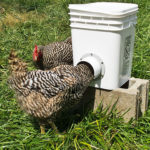
My grandfather built us a chicken coop. I never cared for those chickens, but I don’t know why. I didn’t like the way they looked when they molted or that they sometimes startled me when I was playing in the yard. Sometimes I’d collect eggs, but I tried to get out of it if possible. My mom loved having chickens and didn’t ever seem to mind any of the work they required—feeding them, cleaning their pen, breaking up their water on cold days. I dream of having chickens for their eggs now, but I haven’t told my mom that mostly because I know I’d mind the work even despite her good example.
It’s not just the chickens I have grown into yearning for. It’s the space, the privacy, the variety of the land in the open paddocks and woods, the pond and the marsh. My husband and I have grown so fond of the little home and yard and neighborhood where we’ve raised our kids that I believe he now wants to be buried here. It’s not like the big lots we grew up on, but it is ours. Despite this love and attachment to our place, to the only home our kids remember, I still dream of owning a big open yard and the woods just beyond it like the one of my childhood.
I left my parents’ house, their land, and my hometown more than twenty-five years ago when I went off to school. I married my high school sweetheart, so we came back often to visit both sets of our parents. But when we left, that town no longer felt like ours. Jobs and missions work took us to other states and even across the world. At some point, I became a snob, believing that the people who stayed in our hometown were underachieving.
I now, thanks to the lessons I’ve learned from Wendell Berry, I believe many of those who stayed were choosing to belong.. For almost my first fifteen years as an adult, we flitted from address to address, for what seemed to be good reasons, and had little attachment to any one place. It became easy to look forward to the next move, to the next adventure, and to see any roots grown in a place as temporary. I believed that as long as I was committed to the people I moved with, I was doing it all right. But now I think a commitment to place is almost as important as a commitment to the people. It’s hard to disentangle the two.
My parents have never read Wendell Berry, and neither were raised in the area they’ve called home for forty years. They didn’t set out to stay for decades and outlast everyone else. They weren’t making a statement or trying to beat a record. They just kept living, kept learning, kept knowing. They naturally fell into their commitment to their land, some reasons being pragmatic and some being idealistic. In the last decade, my dad took to riding his golf cart across the acres, bumping across uneven land and sticks and branches in ways that golf carts probably aren’t meant to travel. My mom continues walking her property, often multiple times a day. They both know the stories of the tree and the plants. They can tell you what areas to avoid if you don’t like poison ivy and which trees they planted and which ones just grew and stuck around long enough that they get to stay. They know the wild animals who, despite no invitation, creep quietly on their acres.
My parents are still filled with joy when children run the land. It’s happening less these days as many of their grandchildren are reaching adulthood. When my children were younger, they used to tumble out of the car as soon as we arrived at my parents, flanked immediately by their cousins, and for hours, they’d play the same games my siblings and I did growing up. My dad loved to sit outside by his garage and watch the kids playing. My mom, not someone to sit still for very long, often joined the play. It’s been years now since my family has been at my parents’ house at the same time as my siblings’ families, so memories of the cousins playing are fading. But when my husband and I take our family, the kids find something to do—a golf cart ride with my dad or a walk in the garden with my mom. And I look at the land and think of all the years that have passed since my parents brought us children to look at that land for the first time.
It’s not the same as it was then. The mulberry tree was struck by lightning and eventually had to be chopped down. New trees were planted along the front and side fences to provide more privacy. A gate was put in by the road after a dog was hit by a car. The chicken coop eventually rotted and needed to be torn down. Some fences were mended and others ripped out. Countless flowers have been planted and tended, and many others have just decided to sprout on their own and grow where they pleased. Landscaping, buildings, pets, livestock, and even people came and went over the years.
Did my parents improve the land? I don’t know. But I know they accomplished something better. They made it theirs. They were not merely residents or owners. No, they were members of that land and the land surrounding it, growing and changing it, loving and grieving it. They planted and tended. They had successes and failures. They gave, and they received. The land soaked up their tears, sweat, and blood. The trees knew their cries and laughs.
My dad had a stroke last month, and for the first time in forty years, we’re wondering how much longer the land can possibly be theirs. I’m gently listening to my mom process what a move would look like and what she needs to take care of my dad. Selling seems imminent, as the demands of the property are probably too much now. It won’t be too long after my parents leave that no one remembers it as their place. Their county, with its close proximity to the D.C. metropolitan area, is home to mostly military or other government commuters who usually stay less than three years before moving on.
There’s a good chance that I won’t ever meet the people who come to the land after my parents. I suspect whenever there are new owners, at least at first, I won’t want to meet them. It seems too hard. But I hope they love the land. I hope they love every bit of it, even the toil and the hardship. I hope that they belong to the land and know that even though the land belongs to them, it belongs to others as well. It belongs to my parents and my siblings and me. It belongs to the spouses and children we brought to the land, all of whom were part of keeping it. It belongs to the people who were before us, whose sweat and tears and blood fell to the ground.
What will the land be like without my parents? Their road? Their county? I don’t know. None of their neighbors do either, because my parents have lived there much longer than everyone else. But such is the way of life: we come, and we go, one way or another. Will the new owners love that land as much as my parents? I hope so. But I know they won’t love it more.

1 comment
Connor Curley
Beautiful reflection. Your experience and anticipation of handing on if your childhood home touches on several topics close to my own heart.
On one hand, I could imagine the new generation of owners being the recipients of a tradition, one of family, value of the land, stability, etc. Your pondering whether they will “love the land as much as you did” is precisely the fear of the generation now in charge of passing it down.
The second thing that struck me is your line about it being easy to suppose that you “owned” that land. What are we but stewards of what God had entrusted to us!
Great reflection, thank you.