

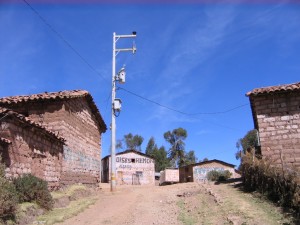
“Come in and look,” Quintín urged me, as he disappeared with a shuffle through the low doorway in his adobe house. I got up from the wooden bench on which I had been sitting on his small patio, and followed him inside. It was quite dark compared to the bright Andean sunlight outside. As my eyes adjusted, the first I saw of the room hardly surprised me. There were stacks of papers on shelves in most directions, and books lying about on the table. Quintín had always been a voracious reader, and more intellectually curious than even the other rural schoolteachers I had met over the years.
I sat down on one of his chairs and watched as he proudly lifted a cloth off what turned out to be a television set. He switched it on and a fairly typical Peruvian news programme started resounding through his humble dwelling. It only got one channel, he noted, and he was not quite sure which way the signal managed to get through the mountains that blocked everything else. But he was obviously enthusiastic about the new technology and the daily glimpses of life in the outside world that it was giving him.
The scene would have been impossible not long ago. This village, Pomatambo, had only had electricity for a few months. Other friends with ties to the village had told me before this visit of the arrival of electricity, and I had been curious to find out what effect it was having. My conversation with Quintín that morning had touched on many things. As soon as it turned to electricity, he had immediately thought of his television as one of the most obvious uses for it. As we sat and watched the news report, I asked him how many households had televisions already. He said only about three or four, which out of a community of two hundred or so residents was not many. But it would probably not be long before others joined him. Even in very poor communities like this one, after electricity the televisions follow closely behind, usually cheap or secondhand models paid for by migrant worker earnings and the like. And Pomatambo was obviously equipped. Electricity poles dotted the village streets, with wires leading down to boxes set into the adobe walls of houses, many of which were only occupied part of each year and had yet to be wired inside.
On one level, some of this was heartening. The usual story for Pomatambo over the last few decades has been one of neglect by the state. The last time I was here a couple of years earlier, there had been high tension electricity lines running along the hilltops within sight, a testament to the profitable flow of electricity from one region of the country to another—and, since no one had thought to run lines into the nearby villages, equally a testament to the state’s priorities. So to see that someone had finally budgeted enough to put in the local infrastructure was encouraging. The people of Pomatambo and nearby communities had been asking for it for years.
But it also raised other issues. I had written in my book on Pomatambo, A Path of Our Own, that whenever electricity did come to this village, it would be the biggest agent of change in some decades—as important as the first village primary school or the first movements of migrant workers to the cities in the 1940s and 1950s. Television would undoubtedly be one of the chief ways electricity would work its magic. I asked Quintín himself, a couple of years ago, what he thought television might do here. It bears noting that, even without electricity, he had had some access to broadcast media and was probably better informed about the world than many owners of plasma screen televisions with all the bells and whistles. He often listened to international news on a shortwave radio, and had watched the Peruvian presidential debate in 2006 on a small battery-powered television, until the batteries gave out in the middle to his exasperation. Obviously he wanted more regular access to current affairs. But being a primary schoolteacher, he also said he was worried about the effects on children of some kinds of television programming—salacious “false propaganda,” as he called it with a stern look. Sitting in his house and looking at the new television, I revisited his earlier comment. He said that that could still happen. Since the one channel that they could get now was a state-funded broadcaster that mostly had news and avoided scraping the bottom of the barrel, however, the problem had not really materialised yet.
To many FPR readers, the arrival of electricity in a place like Pomatambo no doubt brings to mind the core issues of community, self-reliance, and development that we often discuss. Connecting such villages to the electricity grid is something that, as far as I am aware from my conversations, none of the rural poor oppose. They are in much the same situation as rural America was during the electrification projects of the 1930s. Over the years, electricity was among the most frequently mentioned aspects of development that Pomatambans said they wanted, and something that they knew the village would have to have to be even remotely appealing to the younger generation who were leaving in droves. But rural electrification also places the rural poor “on the grid” in a broader sense. Particularly with daily access to television, the influence of global consumer culture will become all the more pervasive.
Electrification is a microcosm for some big questions, including what one might have to fear from being “on the grid,” and how much the problem is the grid itself versus what happens both materially and spiritually to flow through it. Among people who worry about such things—and, with a few exceptions, the rural poor themselves do not worry about them before having experienced them—the fears fall into two broad categories. One has to do with losing control, of being subject to vast external forces for which no one really has close moral accountability. The other has to do with having alien values seep into and rot the fabric of community life.
Perhaps the most deliberate effort to take these fears seriously and head off the problems before they begin has been made by the Amish communities of North America. To outsiders, they are known superficially by their austere old-fashioned attire and by their habit of riding around in horse-drawn buggies. But most Amish communities have had a quite sophisticated approach to evaluating the myriad new technologies that have arisen in the world over the last two centuries. They ask first and foremost whether each technology—with all the patterns of use surrounding it—is compatible with their religious commitments and social arrangements. Many Amish communities have electricity generators, therefore, but do not connect to the public grid because it represents a form of dependence. Television is out, because it distracts from the vibrant internal life of the Amish village and exposes the young to unsalutary influences.
Few traditional communities have the steady religious authority and time-tested social cohesion to make these assessments and stand by them like the Amish. Pomatambo is already loose enough, because of migration and education, that it certainly does not. But among thoughtful people like Quintín, there is a consciousness of many of the same issues. And there are hard tradeoffs involved, especially if we try to think about exactly what is to be sought, what avoided, and how to do so.
Loss of control can only be avoided entirely if one meets all needs locally. Suppose that one wants electricity—as do all Pomatambans to whom I have spoken, for reasons as basic as wanting light to stay up by in the evenings without inhaling candle smoke. To have it under their full control, they would have to generate it locally using solar panels, windmills, and the like. In the future, that may well be possible; and I have met a few independently minded people in developed countries who use solar panels to cover the electricity usage for at least their basic household appliances. Such self-reliance would also be intuitively appealing to distributists like G.K. Chesterton and Hilaire Belloc, who were rightly suspicious of depending on large conglomerates whether public or private.
As I have had to point out before to the more technology-conscious Pomatamban youth, who get wild ideas about small solar panels to power computers, however, such equipment is still rather expensive for the context. If places like Pomatambo want to stay off the grid, it would mean waiting quite a long time for amenities like electricity. Moreover, there are economies of scale to many other desired amenities and activities. The rural poor are acutely conscious of losing control over their own lives, to be sure. They are aware that there is a wide spectrum of possibilities between being a consumer fully “on the grid” and living in secluded destitution. But I very much sense that most of them would not pick the most isolated end of that spectrum, if it comes down to it.
The intrusion of alien values, especially via the media, is a somewhat different question. Most Pomatambans over the age of about forty find the Western-influenced music tastes of the young quite off-putting. And one young local musician who plays traditional Andean music told me that he finds it frustrating to be constantly up against competition from rock and rap. The more seamlessly and pervasively one is connected to the global grid, the more this and similar trends will continue. Sheer volume of exposure does matter.
How much the fears of traditionalists are justified here will depend on which school of thought about global media one finds persuasive. Most critics speak of “media imperialism,” the view that global media spread cultural norms and images that originate in the West, and particularly in Hollywood, to the rest of the world. In that account, global media flatten cultural diversity and defeat traditions. A rival “transculturalist” interpretation holds that media are always filtered through the distinct cultures of local audiences, and get appropriated in different ways. I am inclined to think that much of this hinges on what level of cultural change one has in mind. Yes, media culture—and all that it links to in behaviour and self-image—probably will continue to vary somewhat from place to place in superficial ways. There will still be Andean folk music on Peruvian television fifty years from now, some of the time. But look a layer deeper. The overwhelming pressure of global media on behalf of liberal modernity, and against many of the virtues and commitments of traditional folk, is hard to deny.
This brings us to the crux of how we are to think about this problem of being “on the grid”—more specifically, of how far to be on the grid and in what ways, especially in the case of communities in parts of the world that have not yet fully committed themselves. Now for many thinkers to whom most of us are sympathetic, the scale of the grid is key. We find this in the writings of Mohandas Gandhi, who wanted India to go back to the face-to-face humanity of village life and reject large scale industry; in the “small is beautiful” affirmations of simple technology and regionalism in E.F. Schumacher; in the agrarianism of Wendell Berry; and in the “place-based practices” celebrated by Arturo Éscobar. There are powerful reasons why they think that enmeshing oneself in large scale economic and cultural flows can work to one’s detriment. I wholly agree that prudence often favours an adequate measure of local capacity, that decisions should be taken close to those with a stake in them, that there are often profoundly virtue-inducing effects of subsidiarity, and that a diversity of places and traditions is a valuable part of our heritage.
At the same time, however, I fear that we often have a tendency to confuse scale per se with content. I recall a conversation I had some time ago with a committed fan of Wendell Berry. We were talking about alternative approaches to rural development, and I must have set off some alarm bells for my friend with the suggestion that more networks among communities were crucial. We got into a debate about whether the mere fact of building a road to an isolated village does it some harm, or whether the real problem is what happens to lie at the opposite end of the road. I am inclined to think that if at the other end lies another village of similar disposition, then connecting them can only multiply their strengths. If so, then the best thing anyone can do for places like Pomatambo is not to oppose roads, but to make sure that more roads—and perhaps most crucially, more of the early roads—lead to other villages rather than to Babylon.
This applies in many dimensions of what modernisation can mean. It applies economically, in the circuits of interdependence that, whatever justified apprehensions we might have, are going to be necessary to deliver the goods materially for the rural poor. Local farmers’ markets give us much to celebrate. But whether in Appalachia today or the Andes tomorrow, people are not likely to give up many of the products they find on the shelves of Walmart. The way around that might not be to discourage buying at a distance on principle, but to figure out how to buy at a distance in ways that reinforce the communities of both buyers and sellers, rather than working at cross purposes with them. This is not limited to experiments in such niches as fair trade coffee, either. Perhaps we should amble around the aisles of Walmart and think of how very different kinds of products might circulate along different, more ethical, pathways.
My sense that more pathways of the right kind need opening up also applies to culture and communication. If Quintín’s television starts showing Laura Bozzo—a more unsavoury Peruvian clone of Jerry Springer, if one can believe that such people exist—then that is a problem of content rather than scale. I should be tempted to put an adobe brick through the screen. But can we imagine it showing Pomatambans scenes of life in some Berryan corner of Kentucky, and vice versa? That very different situation could only benefit people at both ends. If so, not only should I put down the brick I had at the ready. I might even go out and buy some more televisions for Quintín’s neighbours.
Or take the internet, for a more decentralised and user-generated kind of content. At present, the dominant tone of the internet reflects the centres of power and wealth in the world, and the cultural pathologies that tend to afflict them. But imagine a counterfactual scenario in which the internet connected only people like Quintín and his fellow villagers to one another. Would the mere fact of a new connectedness suddenly compel such people to start down a primrose path to vacuous self-indulgence? Given a certain view of human nature, then I suppose one might argue that lubricating such exchanges would speed up a race to the bottom. But I suspect that most of the FPR crowd would find that scenario a bit far-fetched.
Now I do not suggest for one moment that building more roads among villages rather than away from them—on whatever level of metaphor or practical application one might prefer to think of the idea—will be an easy task. In many cases where it is most vital to do so, it would mean taking a harder and less intuitive route out of severe poverty, by bypassing the immediate options that the global market dangles so enticingly. But if the issue can be reframed this way, then we can at least begin thinking about room for an alternative that otherwise would not exist.




5 comments
NL
Interesting article. The usual trajectory is that most people only realize the value of what´s being lost after it is lost. However, thankfully, there are enough books that chronicle such loss that people refer back to them to reconstruct more humane elements of what was lost.
PDGM
Good article; and thank you.
But when you talk about “a problem of “content rather than scale” I wonder whether you are being naive. The infrastructure for electricity, for internet access, comes from large corporations, who have a very direct interest in remote people’s access to the wants, the putative “needs,” of the first world consumer economy. Until this is no longer true (and how to get there?), scale and content will remain completely linked. They are different in mind, but not in reality.
A related anecdote. I was on a reservation, watching a ceremonial dance in which a friend was dancing. During a break in the dances (they last from sunrise to twilight with breaks), I went to his house to rest and get out of the sun. His grandchildren were inside the house, watching the boxed set of “Texas Chainsaw Massacre” movies.
This vignette shows the difficulty of balancing local culture with global entertainment; and until scale and content are severed, I’m afraid that the entertainment will steamroller the local culture.
Weasly Pilgrim
I echo Prof. Fox’s praise. As I suspected upon reading the introductory post, this discussion will be quite illuminating.
This idea of parallel networks is intriguing, and in many ways is an application of other sorts of alternative thinking to the specific challenges of rural poverty. We already see these alternative pathways springing up in other contexts, such as agricultural localism or homeschooling, where people and communities organize outside of and parallel to the mainstream.
But I see the same difficulties arising that these other alternative networks have to deal with (and increasingly, succumb to). How do we work out such parallel regional networks when the apparent thrust of government and business is toward ever-greater centralization, even to the point of making it illegal to form alternate pathways? The Amish have managed it in modern times, at least to a point, because of the wide latitude granted them under religious conviction exceptions. But their relative independence is fast eroding as their practices increasingly conflict with zoning regulations (think outhouses) or public health initiatives (vaccinations) or agricultural regulation (animal tracking, manure handling, business permitting and licensing to name a few).
It seems to me, in connection with Susan McWilliams’ post on civil disobedience, that we traditionalists may expect that some kind of civil disobedience will eventually be necessary to make the connections and build the alternate pathways you suggest, and that I find to be compelling. Perhaps this isn’t necessary yet (and given the economic situation, may never be necessary), but the net seems to be tightening and the flexibility to work outside the “approved” channels seems to be disappearing. I’m not sure what to think about this.
Russell Arben Fox
Adam, this is quite possibly the finest essay I have read on this sight yet. You pose what I think to be the very hardest questions, and most important questions, which localists of all stripes must confront, in a manner that is grounded in real world examples, but which does so in light of the larger, more philosophical concerns. The needs of the rural poor are real material needs, needs which they live with daily and know very well: the lack of medical care and educational options, the difficulty of transportation, the paucity of information. Modern markets, modern bureaucracies, and modern technology have demonstrated great ingenuity in paying for and making profitable the delivery of such things as hospitals, schools, roads, electricity and media access to the far corners of the world. But the delivery of such almost inevitably disempowers those who live there, making them dependent upon outside elites and distant opportunities, luring many (especially young people) away and corrupting the local traditions which had developed in those poor communities in the meantime.
So how to balance these things? For balance them we must; even those most cranky of us are probably sufficiently attendant to basic Christian principles or human rights or simple egalitarianism so as to be unwillingly to deny the poor those things they desperately need to live fuller lives. And it’s not like many young people don’t leave small rural communities anyway, however connected they feel to their families and local cultures, driven away by the relative (or absolute!) deprivation they see their parents experiencing. (Folks have been leaving the farm and the village for the big city for centuries.) So we are left with balancing. Your thoughts explore one element of such a balancing: delivering goods in a way which bypasses already loo-large concentrations of work and wealth, and which instead seek to connect small, disparate places together. Such regional networks are, I think, crucially important, and yet there are too-few real-world examples of them out there for us to dwell upon and use as models. Thanks very much for giving some food for thought about what might go into building such models. I suspect I’m going to be coming back to this essay of yours again and again.
Comments are closed.