

Last week, Philip Bess – the noted Notre Dame University scholar of architecture – delivered a lecture in Washington under the auspice of the group “Conservatism on Tap.” Bess’s lecture was a first-rate summation of his book, Til We have Built Jerusalem, a remarkable and persuasive effort to relate the principles of new urbanism to natural law.
In one arresting metaphor, he compared our current living arrangements to that of a disassembled pizza, in which we have separated out the various parts of the “pie” – residential, retail, work, school, worship, and so on – and thus rendered the delectable assemblage of life’s goods into tasteless and boring ingredients.
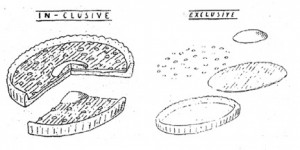 He argues instead on behalf of the integration of life’s activities – for the “whole pie” – as a living arrangement that accords best with our nature as human creatures that aspire to integration, to the achievement of wholeness of our many parts. As he writes in his book, discussing this specific metaphor,
A neighborhood is to the larger city what a slice of pizza is to the whole pie: a part that contains within itself the essential qualities and elements of the whole. In the case of a city made of neighborhoods, this means that a neighborhood contains within walkable proximity to one another places to live, work, play, learn and worship. Within the legal boundaries of a postwar suburb, by contrast, the elements of the “pizza” are physically separated and at some distance from one another — as if the crust is here, the sauce over there, the cheese someplace else, and the pepperoni way out yonder.
Bess’s argument, to my mind, was superb and utterly persuasive (just as his indictment of the suburbs was devastating). What was lacking – and cannot at this point be wholly provided by a professor of architecture, nor, for that matter, a professor of anything else – was a corresponding argument that living in conditions akin to “the whole pie” fosters and sustains the moral environment. That is, the next step to be taken is an investigation into the relationship of objectively good built environments and objectively good moral human communities – ones that support the good lives of families, neighborhoods, communities; that reinforce good behaviors in our economic and social lives; ones that aspire to preserve and transmit traditions and memory from the past and thoughtful regard for the future; ones that neither treat the “environment” nor other humans as mere means to our narrow ends of personal satisfaction. Bess’s argument – which all should read and consider – takes us a considerable distance in establishing that there are objectively true reasons for preferring a certain built environment. More conversations need to be had on the Front Porch and elsewhere exploring the connection between where we live and how we live.

4 comments
Philip Bess
Patrick:
Thank you for your kind words about my recent talk in DC. I need to correct one thing however: the analogy (and the drawing) of a city neighborhood being like a slice of pizza—a part similarly related to the whole—does not originate with me, but rather with Leon Krier, whose insights about traditional urbansm I am happy to share with whoever will listen.
I have been following with interest the Front Porch / PoMoCon exchanges throughout the summer, and hope to find time at some point to suggest how New Urbanists, for all we have to learn from this exchange, might also have something of value to contribute. Here I will simply say, with regard to the “what else” is needed in addition to good places for human beings to live well, that I concur with both the FPR writers and the PoMoCons that character virtue is essential to human flourishing and that it develops in the context of communal commitment and obligation. There seem however to be two broad areas of disagreement between you: one over whether and/or how much place really matters to human flourishing, and the other over whether modern society and culture can themselves promote and sustain the formation of good individual character habits. Clearly, I think that place matters; but I am more ambivalent about how well modern societies encourage character virtue. I address the latter subject at some length in the first chapter of Till We Have Built Jerusalem under the different and perhaps oppositional virtue-rubrics of “Tocqueville” and “Benedict;” and only mention this to say that the book’s subsequent arguments for traditional architecture and urbanism should be read in light of the anthropological premises articulated and the cultural questions raised in that first chapter.
Patrick Deneen
D.W.,
Absolutely right. Bess’s normative/anthropological arguments significantly move the issues of new urbanism into a different sphere that implicates far more than building styles, driveway placement, etc. The connection to arguments of natural law implicate economic relations, broader issues of local and regional economy, more comprehensive issues of human scale, ultimately whether communities can govern themselves in significant ways (subsidiarity), e.g., keeping out things that are now virally present everywhere (from pornography to Wal Mart – not that they are all that different). It’s an encouraging direction, and one I want to encourage directly.
D.W. Sabin
There is a lot of good work in the New Urbanist and New Classicist wing of architecture and planning. Unfortunately, it is restricted to Town-making as a merely aesthetic exercise with a side order of social planning. It is , in short, shoveling shite against the tide. A properly organic town will evolve the layout prescribed by the New Urbanist only when there is a properly proportioned horizontal and vertical economy. These New Urbanist enclaves exist as tourist paradise or episodic gems within a larger oozing mess because the fundamental underlying economic and transportation paradigm is a bloody wreck. Collectively, we are historicides and motion junkies whose homes …up until recently …are a form of currency and our towns simply some kind of ad hoc essay in “lifestyle” rather than sustainable vessels of life. We carve out an ever-reducing bubble of meaning within the expanding morass and take our New Urbanist victories when we can. Packaging, in this day and age appears to be good enough.
I like that there is a social thinker, not an architect…delving deeply into New Urbanism. We also need economists..or better yet, some kind of anti-economists to start to do so. Leon Krier and Thorsten Veblen should do lunch. Yea, I know the old coonskin hatted prairie populist was a little off his rocker but Ayn Rand and her Milton Friedman brigade tried to meld architecture and social-economic thinking together and we get Corbu’s Radiant City with a side order of Greenspan’s lugubrious “Irrational exuberance”.
Comments are closed.