


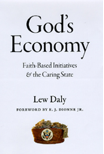
This is a precis of the author’s book God’s Economy (University of Chicago Press, 2009).
New York City, New York. “The transition of an oppressed nation to democracy,” proclaimed the French First Republic’s Committee of Public Safety, created in 1793 during the Reign of Terror, “is like the effort by which nature arose from nothingness to existence. You must entirely refashion a people whom you wish to make free, destroy its prejudices, alter its habits, limit its necessities, root up its vices, purify its desires.” With their vision of an almost plastic human nature, purifiable in the cause of creating a new society, these extraordinary lines were a focal point for Robert Nisbet’s assessment of revolutionary liberalism in his masterwork The Quest for Community. Nisbet also marveled at the French revolutionaries’ fury toward traditional forms of association and loyalty, with their desire, instead, for a new social order based on “free conventions between individual and individual,” as Turgot had put it a decade earlier. This was “one of the most explosive outbursts of individualism in the whole history of the world,” Nisbet concluded.
The most enduring French conservatives of the first half of the nineteenth century, men like Bonald, Lamennais, and Tocqueville, did not simply fear anarchy from the principles of 1789, of course. Rather, the far greater threat posed by liberal individualism, they saw, lay in the new forms of centralized, generalized power and authority that would necessarily arise as universal natural rights supplanted localized order, corporative regulation, and diverse forms of law. Tocqueville’s famously prophetic lines about the rise of an “immense and tutelary power” over the newly individualized masses in Democracy in America set the terms for this dialectical understanding of the political dangers of liberal individualism. But more than Tocqueville, in a manner closer to the more religious thinkers Bonald and Lamennais, Nisbet later stressed how this paradox of liberal tyranny–”militant libertarianism” within society giving rise to a powerful new monistic state—depended on, indeed grew out of, the destruction or limitation of all competing forms of association and all other sources of lawful obligation, from the Church in its multiplicity of offices, orders, and public missions, to the craft guilds and journeymens’ compagnonnages, to the most basic and prevalent social structures of the rural majority—the peasant commune, family property, and even the nuclear family itself. This “social pluralist” critique, as Nisbet termed it, emphasized how “the state becomes powerful not by virtue of what it takes from the individual but by virtue of what it takes from the spiritual and social associations which compete with it for men’s devotions.”
In August of 1789, after the Parisian insurrection and the taking of the Bastille on July 14, the National Assembly (created the previous June) set about abolishing the elaborate system of privileges upholding the First and Second Estates, from feudal dues and services, to proprietary offices, manorial courts, and tithes and plural benefices, to the aristocracy’s exemption from taxation. The annihilation of such privileges was famously the vision of Abbé Emmanuel Joseph Sieyès in What is the Third Estate? But for Sieyès and other republican theorists, abolishing aristocratic privilege was part of a much deeper vision of political transformation. It was a vision of a state-centered “dissociative democracy,” a totalistic politics in which the nation and the state become unified by dissolving all other orders of lawful existence outside of the selfhood and property of individual citizens. By the early 1790s, with decrees against the cloistered orders and secular congregations, and the famous d’Allarde and Le Chapelier laws abolishing trade unions and other corporations, revolutionary liberalism pressed further and further into the corporate and communal structures of French society and its producing classes, the artisans and peasants.
In his recently translated study of anti-corporatism in the French republican tradition (Le Modèle politique français; in English, The Demands of Liberty), the political historian Pierre Rosanvallon brings to light the fascinating legislative debates surrounding the natural legitimacy and legal status of religious communities in the early years of the French Revolution. Pierre Athanase Torné, bishop of the Cher, spearheaded the debate in the National Assembly, introducing powerful anti-corporate themes shaped by a broader political vision which saw the social functions of education, health, poor relief, etc., traditionally performed by religious orders and congregations, naturally being transferred to the state in the service of rationalizing social welfare and the broader social order. Although Germany established the first national social insurance programs in the 1880s, in reaction to the threat of socialism and the political mobilization of labor (what became the German Social Democratic Party was founded in 1869), French thinking about l’État providence (as mid-nineteenth century critics derisively labeled it) originated much earlier as part of the anti-ecclesial, anti-corporatist project of Jacobin liberalism.
Thus, social welfare provision was a battleground in church-state conflict from the very beginning of its modern, liberal-secularist phase in the late eighteenth century. Indeed, even as the Catholic Church and other established or semi-established churches in Europe conceded political disestablishment in many respects by the middle of the nineteenth century, church-state conflict in the realm of social policy only escalated in subsequent decades as emerging welfare states sought to impose various fiscal and regulatory measures designed to restrict the churches’ remaining public offices in education and social welfare. The post-disestablishment encroachments of the welfare state inaugurated a new type of confessional thinking about the role of the church in society, one based on ideas of plural sovereignty and coexisting spheres of lawful existence. As I argue in my new book, God’s Economy, the well-funded but highly devolved and predominantly “faith-based” social-service systems developed by Christian Democratic parties in Europe are one major legacy of this social-pluralist intellectual heritage.
The revolutionary laws that provoked such thinking and set the pattern, arguably, for most forms of church-state conflict as we know it today (in the context of the welfare state) began with the general idea of abolishing the “corporative spirit” of the old regimes, which I pointed to above. The anti-clerical and anti-ecclesial strains in such thinking are well-known, but often underestimated is the role of Physiocratic free-trade thinking. As Sewell shows in his classic study Work and Revolution in France, the roots of Jacobin anti-corporatist legislation lie in Turgot’s failed efforts, as contrôleur générale in the court of Louis XVI in the mid-1770s, to abolish artisanal and merchant “corps and communautés” as well as protectionist tariffs and other restrictive commercial policies, “so that none of our subjects can be troubled in the exercise of his commerce or professions, for any cause or under any pretext whatsoever.” On April 1, 1791, under the d’Allarde law, corporations ceased to exist in France. In May of that year, their corporation abolished, the journeymen carpenters of Paris wrote their own regulations to govern their trade, provoking the master carpenters to petition the National Assembly against this new coalition of workers. The result of this petition against the journeymen carpenters was the famous Le Chapelier law of 1791, the text of which began, “The annihilation of all sorts of corporations of citizens of the same trade or profession, being one of the fundamental bases of the French constitution, it is forbidden to re-establish them in fact, under any pretext or under any form whatsoever.” Any “deliberations” and “agreements” of “citizens attached to the same professions, arts and trades” were thus declared “unconstitutional and an assault against liberty and against the declaration of the rights of man, and of null effect.” Violators would lose their rights as citizens and be heavily fined.
While there is no evidence that the Le Chapelier law was simply an invention of the revolutionary bourgeoisie designed to suppress workers’ wages, as Lefebvre had suggested, in fact the primary legacy of the law in subsequent decades was precisely that. Workers’ organizations remained illegal in France until 1884, when the Le Chapelier law was finally repealed. Sewell’s great contribution in Work and Revolution was to show how the workers’ movements of the 1830s and 1840s took the anti-corporative theory of the French Revolution, which had been more and more forcefully honed to repress worker organizing, as their cue for resurrecting pre-revolutionary communal idioms, recast, increasingly, in a class-based language of producer solidarity against an economically liberated but socially lawless bourgeoisie. One of the worst failings of recent American conservatism has been to ignore the anti-worker legacy of the French Revolution. In fact, outside of what happened to the Church, the legal suppression of worker organizing was the primary political legacy of revolutionary liberalism in the nineteenth century.
Nisbet’s Quest for Community exhumed the social-pluralist critique of nineteenth-century liberal statism, a critique that made its mark not only in France but in England, Germany, the Netherlands, and elsewhere in Europe. As Nisbet understood, this alternative conservative tradition was one that saw market freedom and liberal statism as philosophically interconnected in a unified project of anti-social domination. My book God’s Economy, in turn, reexamines the nineteenth-century legacy of social pluralism through the lens of today’s faith-based initiatives, the development of which, I demonstrate, was subtly but powerfully shaped by this older European tradition over the last three decades—with implications extending far beyond the limited domain of social services, I further argue.
In tracing the social-pluralist lineage of today’s faith-based initiatives, I pick up the story as it enters its distinctive confessional-political phase in the second half of the nineteenth century, marked by the rise of Catholic parties in Central Europe and (perhaps most dramatically) by the rise of the orthodox Calvinist Anti-Revolutionary Party in the Netherlands, led by Abraham Kuyper. Both Catholic and Reformed confessional traditions were strongly influenced by French counter-revolutionary thinkers as they sought to defend religious schooling and social welfare programs from being swept away by disestablishment and by the rise of public welfare systems. What emerged in this struggle between confessional institutions and the liberal state—understatedly described in the name it was given in Germany, Kulturkampf or “conflict of worldviews”–was a concept of plural sovereignty. Political order, in this view, was comprised of a plurality of sovereign group-domains, each ordered to its own distinctive nature and purposes and all held in balance across society by a limited but supportive public authority.
The first half of my book mainly focuses on detailed policy history culminating in President Bush’s sprawling effort to “level the playing field” for faith-based social providers, working outward across the government from his newly established White House Office of Faith-Based and Community Initiatives. Bush’s faith-based initiative sought to reformulate church-state boundaries in the social safety net and to actively increase the role of religious bodies in statutory aid programs. While this was something utterly unique in presidential history, it was also in many ways a logical outgrowth of developments in church-state law and legal theory over the last three decades, as strict separationism gave way to “equal access” and “substantive neutrality” principles in a series of landmark Supreme Court cases beginning with Widmar v. Vincent in 1981. I also argue that the changing political economy of the U.S. welfare system, as the share of federal welfare spending dedicated to social services grew dramatically beginning in the mid-1960s, created fiscal and policy compulsions which made it all but inevitable that church-state barriers in social welfare programs would be lowered—an analysis I develop more fully here.
In the second half of the book, I explore the social-pluralist genealogy of the faith-based initiative, examining in depth the political theology and legal philosophy of this tradition as it evolved through confessional struggles and beyond, across the long nineteenth century. The strongest sources for this tradition are found in social Catholicism (Bonald, Lamennais, Émile Keller, Bishop Ketteler, Pope Leo XIII) and in Dutch anti-revolutionary thought (Groen van Prinsterer, Abraham Kuyper, Herman Dooyeweerd). The common root of these varied confessional traditions of social pluralism, I argue, was the idea of libertas ecclesiae, reaching back to the New Testament vision of distinct but coexisting spheres of authority and law—God’s and Caesar’s. This idea of dual or plural sovereignty was refined in Papal teaching, from Gelasius I’s famous Duo sunt (“Two there are”) in his dispute with Emperor Anastasius, to the reform vision of Gregory VII, culminating in the great Investiture Contest of the late 11th century.
Beginning in the latter decades of the nineteenth century, legal and political historians such as Otto von Gierke and (later) J.N. Figgis and Harold Laski broadened the influence of social pluralist thinking in law and politics, and after World War I, Gierke-influenced German Jesuits, most importantly Heinrich Pesch, Oswald von Nell-Breuning, and Gustav Gundlach (who in turn greatly influenced Pope Pius XI) gave comprehensive expression to the social pluralist vision in the principle of subsidiarity and the model of a subsidiary state. In this view, now of course a cornerstone of Catholic social teaching, the freedom of the church came to be seen as a template for the freedom of society across a broad spectrum of natural human spheres, from the family, to youth education, to organized labor.
I needn’t explain here the tendency among American conservatives to interpret subsidiarity as a Catholic version of the Republican Party’s libertarian agenda of dismantling government agencies and privatizing entitlements and services. Of course it means nothing of the kind: subsidiarity is not a theory of local control or minimal government; it is a theory delineating precisely the critical role of central government in assisting natural social structures, beginning with the family, when they are weakened in the order of society. The properly subsidiary role of the state is to support, for example, the family, without distorting or usurping its place in the order of creation or its purposes as given by God. Unlike the liberal welfare state, a subsidiary state recognizes the prior ground of family and other natural spheres and does not encroach on the legal and moral autonomy they derive from God; but unlike liberal anti-statism, the subsidiary state is responsible for protecting and supporting the natural spheres when they are violated within society or otherwise falter. For example, when wages fail to support workers and their families in their proper dignity, the sanctity of the family is violated and the state must intervene, either by strengthening the power of workers to extract higher wages from employers, or by compensating families directly out of the public purse. Against the moral anarchy created by “market laws” that push working families beneath their dignity, a properly subsidiary state delineates “justice” by strengthening the weaker spheres against the stronger, those given by God against those ordered by men. In upholding and protecting such “sphere sovereignty,” as the Kuyperians termed it, the state “brings stability to the land,” and this, Kuyper insists, is called “justice.”
In the background to modern subsidiarity teaching, the opponents of revolutionary liberalism at the dawn of the modern era understood the dialectical relationship between individualism and statism. The latter does not arise without the former’s destruction of all other forms of authority and protection within society. As Nisbet put it, “the state is a refuge for the moral consequences of individualism,” adding, further, that the new “laissez faire individualism” of the nineteenth century was not “the simple heritage of nature,” but rather a calculated, collaborative product of economic interests and centralized power:
It was brought into existence by the planned destruction of old customs, associations, villages, and other securities; by the force of the State throwing the weight of its fast-developing administrative system in favor of new economic elements of the population. And it was brought into existence, hardly less, by reigning systems of economic, political, and psychological thought, systems which neglected altogether the social and cultural unities and settled single-mindedly on the abstract individual as the proper unit of speculation and planning.
In Article 2 of the Declaration of the Rights of Man and Citizen, individual property was joined to “liberty,” “security,” and “resistance to oppression” as one of the “natural and imprescriptible rights” whose preservation must be the singular object of political power. As Sewell writes, under revolutionary liberalism, “property was no longer, as under the old regime, to be subject to manifold public regulations bringing its use into harmony with a pre-established public order.” Public well-being would instead be improved “by setting citizens free to develop and maintain their private persons and properties as their individual sovereign reason judged best.” While the National Assembly moved quickly to abolish radically unpopular forms of ancient property, such as seigneurial dues and services and hereditary rights in public offices, it was the wealth of intermediary bodies and common use—the lands of the Church, the communal lands of the peasantry, and the public forests (the “domain of the poor,” Bonald wrote)–that brought clarity to revolutionary liberalism’s theory of individual property and gave rise to the characteristic trend of nineteenth-century capitalism, toward private, organized, concentrated control of productive resources. These lands in mortmain or common use were the wealth of sovereign community within the body of the nation, impervious to private control or rationalization by the state. To the men of 1789, such degraded “social property” violated the new liberal canons of economic efficiency, administrative centralization, and uniformity of law. As one political spokesman cited by Rosanvallon put it, describing the sale of communal lands, “The constitution recognizes only one corporation, that consisting of all the French….In its eyes, only two types of property can exist: national property and individual property. Nothing is more contrary to these principles than the existence of nontransmissable communal properties.” Ultimately, Sewell concludes, “only absolute individual property survived the Revolution, and this pared-down and purified form of property was placed in a new and much more central place in the social order.”
In bringing social pluralism forward through the example of today’s faith-based initiatives, my central goal in God’s Economy is to reconsider this older and deeper understanding of the “destructive tenets” of liberalism in light of the broader economic destruction now unfolding in many American communities and millions of households. Kuyperian and Catholic social teaching, forged in church-state battles over education, welfare, and family law, unmistakably saw private economic power, no less than public power, as a threat to social autonomy and to the natural sustaining order of family, church, and community. Neither saw the freedom of the church simply in terms of limiting the state, because they could also see how laissez-faire anti-statism promoted society’s enslavement to capitalism. Simply limiting the state to preserve social autonomy while leaving the worker and his family defenseless against destructive economic power did not stand the test of Christian justice.
In words as prophetic of our own economic future as they are revealing of the struggles of the past, Kuyper’s great mentor and the founder of Dutch anti-revolutionary politics, Groen van Prinsterer, lay his country’s “worst ailment,” rising “paupersim,” at the feet of the French Revolution, throwing his support (at least his moral support) behind the radical reformers of the late 1840s. As he wrote in his book Ongeloof en Revolutie (Unbelief and Revolution), first published in 1847, pauperism came from “Liberty and Equality” as understood by the Revolution. Just one detail. When that slogan was first raised, guilds and corporations too had to go. The desire was for free competition; no restraints on skills and industry; no hateful monopoly exercised by individuals or societies; then the development of private initiative and commerce would guarantee a better future.
The future that was envisioned has arrived. Can it be called better? I am of one voice here with the leading spokesmen of the present-day revolution. It is this liberty, this unrestricted competition, this removal, as much as possible, of the natural relationship of employer and employee, which tears the social bonds, ends in the dominance of the rich and the rule of the banking house, robs artisans of regular sustenance, splits society into two hostile camps, gives rise to a countless host of paupers, prepares for the attack by the have-nots on the well-to-do and would in many people’s eye render such a deed excusable and almost lawful. It has brought Europe to a state so dreary and somber as to cause many to tremble and cry out. Is there no way to revive, in some altered form, the associations that were so recklessly crushed under the revolutionary ruins?
Thus, plainly, anti-revolutionary thought was not singularly aimed at liberal statism. It was a philosophy of communal right and family protection, first; but this defensive philosophy of communal freedom grew out of a dialectical critique of liberalism linking the state’s dissolution of community with the objective social harms of free-market capitalism, particularly as it affected family life. In what was perhaps the boldest work in this tradition, Émile Keller’s L’Encyclique du 8 décembre 1864 et les principes de 1789—responding to Pius IX’s thunderous anti-modernist encyclical Quanta Cura (1864), the Alsatian parliamentarian and lay Catholic leader drew attention again and again to the French constitutional determination of private property as a sacred right of freedom, contrasting this with the state’s assault on the freedom of the church. “If any property is sacred,” he wrote, “it must be that which is given up for the good of the poor.” And the only “unlimited liberty” should be the liberty to “unite and to associate” in serving the poor, the children, the elderly, and the sick, in “loaning to the poor without interest, helping workers’ associations advance, and opening well-paid workshops for fathers of families and widows burdened with children.” Only the freedom the church, “which is nothing other than social truth rooted in religious truth…can widen the field of social liberty,” Keller concluded. The proper role of the state is to “openly favor the expansion of [Catholic] activity,” and to “rid itself of the impediments that paralyze the Church.” So too, the state must “content itself with repressing the grossest abuses of the power of capital.” Political suppression of the church, Keller saw, was not a separate order of domination but one closely allied with individual domination in the marketplace: dissolving the economic basis of community went hand in hand with political absorption of the functions of the church.
God’s Economy reveals how the faith-based initiative advanced a pluralistic re-ordering of church-state relations in our social safety net, one that was influenced by Kuyperian and Leonine teachings on the social question. But in the century between these two eras, and especially in the last several decades, social pluralism lost its economic meaning. The Leonine tradition, Pius XI wrote in Quadragesimo Anno, “completely overthrew” the tenets of economic liberalism, “which had long hampered effective interference by the government.” This was the culminating statement in a natural-law revival that began as an attack on political liberalism and evolved into an attack on the economic domination at the heart of the liberal state. Christian Democracy followed this, the true path of subsidiarity, by combining confessional autonomy in welfare governance with a social-transfer system capable of protecting families and communities from the power and volatility of unlimited markets. In contrast, Bush’s strong effort to restore the freedom of the church took the political side of this freedom for the whole meaning of the tradition. At the same time, his supply-side policies benefiting the wealthiest Americans could not have been more antithetical to the social-pluralist vision that inspired his faith-based initiative. So there is still much to learn about the social question and how it should be addressed, despite striking progress in the design of certain policies. We should continue on the current path of pluralistic reform in our public systems, upholding the autonomy of religion; but we should expand our pluralist defenses in society, creating a new legal order of family protection, community wealth, and market restraint. Until we press further in this way, the freedom of the church will continue to fall short of the meaning it once had for the freedom of society.

16 comments
Roman
I am overly excited about this piece. I can’t wait to read the book.
-Member of Dutch Anti-Revolutionary party
hcat
I would like to see some of this analysis applied to land use law. I am far from a philosophical libertarian, but I tend to be a property libertarian, because I think a marketplace of landowners does a better job at providing those necessary but “locally undesirable land uses” (LULUs) like waste dumps, prisons, industry, and (hopefully market-rate) denser and more affordable housing, than a “marketplace of municipalities” where effect on property values, not property rights, is the driving factor – where it isn’t “fiscal zoning” – retail brings in more bucks to city coffers, large lot homes create a lesser burden on government services and traffic than what the market of landowners would give us. Ironically, the “marketplace of municipalities” is in more need of regulation than the “marketplace of landowners.” I would prefer that this regulation be done by a county or super-county large enough to include most of the metro area, or at least a cross section of all income groups and class interests in the metro area.
I tend to think Kuyperianism superior to subsidiarity, because Kuyperianism focuses first on the type of authority, only secondly on its geographical scope. I e “City hall” is still “the government” and General Motors and the corner store are still “business” and the local storefront independent church and the Roman Catholic Church are still “the church.” I don’t want authoritarian government, which presumes that the community ultimately owns my property, out of City Hall any more than I do out of Washington D C.
Wessexman
“I meant by my first question, that since the State is comprised of human beings, each with their own flawed (even fallen) nature, it surely would eventually be corrupted and devolve into tyranny. Perhaps it wouldn’t, though, given the right circumstances. I just tend to be skeptical, given the track record of the state throughout history. ”
Yes being human such a system would be flawed and would eventually fall but so would any human system and this one is simply that which would seem to be the best.
“Certainly. But wouldn’t this imply that a state, by its very nature is vulnerable to the temptations of statism? ”
It can be vulnerable, nothing is perfect and we always have to be on the look out but it would still be the best system any other choice would be either too anti-state to the point it has problems functioning and paradoxically then invites statism or it would be overly statist to begin with.
“You are correct in this assertion. I just find it hard to imagine how there would ever be social cohesion in a society as fragmented as America today. The effects of radical individualism have burrowed too deep in our social fabric.”
I think your in a better position than us Brits. We lack that conscious and cohesive social conservative core.
Bob Cheeks
Brandon, my comment re: your “questions” was not a criticism of you. Keep up the good work!
Pete Peterson
Thanks for your work here, Lew. The book looks very interesting, and I plan on buying it, but I raise two points:
1. There seems to be a leap in the “subsidiarity” conversation from “government” to civil society and then family, without a fuller discussion of what level of government we’re talking about. You are right to say some conservatives define subsidiarity as a philosophical underpinning for a “no government” argument, but it’s not fair to say this is a full representation of the argument. The Federalism argument that Sabin raises (above) is an important, and, given our framework of states, counties, cities, and special districts, is uniquely American.
2. On the issue of Federal social policy you should be careful again about the actual effects of government involvement. Even on a policy that has been so lauded (though unsustainable) as Social Security came under this attack by Nobel laureate, Gary Becker: “parents who do not need support when they become old do not try as hard to make children more loyal or guiltier or otherwise feel as well disposed toward their parents. This means that programs such as social security that significantly help the elderly would encourage family members to drift apart emotionally, not by accident.”
Brandon
No impoliteness intended, Wessexman. It was simply a friendly rebuttal to Bob’s implication that I ask too many questions.
I meant by my first question, that since the State is comprised of human beings, each with their own flawed (even fallen) nature, it surely would eventually be corrupted and devolve into tyranny. Perhaps it wouldn’t, though, given the right circumstances. I just tend to be skeptical, given the track record of the state throughout history.
“There is a difference between having a state, even a a state beyond the local level, and statism.”
Certainly. But wouldn’t this imply that a state, by its very nature is vulnerable to the temptations of statism?
“Culture and society have parts beyond the local and there would be chaos and dislocation if we totally removed any higher power than the local community.”
You are correct in this assertion. I just find it hard to imagine how there would ever be social cohesion in a society as fragmented as America today. The effects of radical individualism have burrowed too deep in our social fabric.
“The important thing is to have a system that maintains the balance and the autonomy for these local and intermediate areas and we will not find that by simply, I’m afraid somewhat utopianly, hoping a world of townships may provide it.”
I pray that such a system can eventually be found and can be sustained without falling victim to the inherent corruption that governmental structures often do. Still, the kind of system you mention appears smack slightly of utopianism itself. Then again, I could be mistaken.
Thank you for the well thought out answers, they are much appreciated.
Wessexman
What do you mean too few answers? I haven’t had a chance to answer them yet. Don’t be impolite.
“But won’t the State, which is inevitably collective, eventually become corrupted by its members? ”
I’m unsure what you mean by this. There will be tension certainly when an ideology of individual autonomy if perpetuated under a collectivist, statist system such as that of the Jacobins. However the lack of community will destroy the very wish or ability of too much autonomy from state tutelage in many people.
“Obviously some form of government is inevitable but does it have to be a central government? Radical individualist anarchy and statism are two extremes. Surely there has got to be middle ground that does not favor centralization of human power.”
Indeed, it is what we are talking about and is in some form or other, no matter how flawed the conception, of a many ideologies. There is a difference between having a state, evena a state beyond the local level, and statism.
“Cannot a theory of anarchism be envisioned that favors community, family, and tradition yet is hostile toward centralized human control (the state)? I always thought that the purpose of localism and decentralization was to keep “The State” in its all powerful and tyrannical form from existing.”
It is unlikely that a stable form of such “anarchism” could exist. Culture and society have parts beyond the local and there would be chaos and dislocation if we totally removed any higher power than the local community. Most of us localists and decentralists are not anarchists or fundamentalist localists. We want to return a lot of power to the local level and to revive the intermediate associations of society, we want more regional and local sustainability but we do tend to recognise the balance and functions that higher levels like regional and national gov’t generally must provide. The important thing is to have a system that maintains the balance and the autonomy for these local and intermediate areas and we will not find that by simply, I’m afraid somewhat utopianly, hoping a world of townships may provide it.
Brandon
For which I’m getting way too few answers.
Bob, my friend, I ask questions simply so I can learn different perspectives and enrich my understanding. Feel free to ignore them if you find them tedious.
Bob Cheeks
Brandon, dude, you’re asking way too many questions!
Brandon
But won’t the State, which is inevitably collective, eventually become corrupted by its members?
Obviously some form of government is inevitable but does it have to be a central government? Radical individualist anarchy and statism are two extremes. Surely there has got to be middle ground that does not favor centralization of human power.
Cannot a theory of anarchism be envisioned that favors community, family, and tradition yet is hostile toward centralized human control (the state)? I always thought that the purpose of localism and decentralization was to keep “The State” in its all powerful and tyrannical form from existing.
And as for the state “staying in it’s place” how does one propose we do that?
Wessexman
Collectivism itself it however made stronger by giving individual more autonomy and freedom from the restraint of intermediate associations, customs and traditions. It often aims consciously to do this.
Libertarianism and Anarchism are unworkable and by their hostile attitude to even social authority and any non-completely voluntaryist social association, not to mention their sociologically and psychologically individualist philosophies, tend to undermine the necessary health and stability of social bonds which are absolutely necessary to resist state tyranny.
Ultimately the state is inevitable and far from necessarily a bad thing(I would say it is a divine institution.) as long as it stays in its place.
Brandon
I read your article with great interest, Mr. Daly. While I fully understand “the dialectical relationship between individualism and statism”, I remain skeptical of the “subsidiary state” solution. This line of thought has Catholic origins. Unless I missed something, doesn’t Catholicism inform us of the fallen nature of Man? Wouldn’t any centralization of this nature in the form of a state inevitably be corrupted at some point?
It is for this reason that, while I believe in community, I find myself politically drawn in the direction of philosophical anarchism or at least libertarianism.
Not all statism is driven to fruition by individualism. Many tyrannical states in history have been driven by collectivist ideology.
Hence, I cannot see how replacing one state with another is any solution. Perhaps someone here could enlighten me as to what I’m failing to grasp.
D.W. Sabin
Subsidiarity as a return to the Federalism of Original intent. ….this ought to twist some shorts.
Bruce Smith
Ah! The Orthus Syndrome where Orthus the two-headed hound from Hell with burning eyes and sharp teeth watches over and guards the underworld of Hades the home of Socialism and Libertarianism and where the Lord of Hades exercises his evil power to pervade the world above with monopolizing government and capitalism from which it is now truly hard for mortals to escape. The two snarling heads of Orthus symbolize these two monopolizing evils.
(Greek mythology apology. I have used the Latin spelling of Orthus instead of the Greek Orthros and I’ve sent Cerberus, the true guarding hound of Hades, to the dog pound because he has three heads and, therefore, doesn’t fit into the symbolism. According to legend Orthus was a mere cattle guard but fierce nevertheless.)
Congratulations Mr Daly on what promises to be a very well researched book and a very strong thesis.
John Médaille
Lew, a great essay, I look forward to reading the book. It is somewhat refreshing to see Lamannais described as a conservative, but I think that is the correct interpretation. Gregory XVI’s attacks on him in Mirari Vos and Singulari Nos read like internet flame wars, and indeed he did back an ostensibly modernist program of freedom of religion, press, etc. But the motto of L’Avenir was “God and Liberty”; his support of democracy was always in a religious context. It is possible to read Gaudeam et Spes as a vindication of Lamannais.
Wessexman
An excellent article and it seems a very worthy book. You really show the links between distributism and the social pluralism of the classical conservative tradition(most succinctly expressed by Nisbet.).
My only criticism is that there are perhaps times where you become just a tad too socially democratic or at least times when your meaning is open to that interpretation.
I too agree the state, even the central state, has an important role in supporting the vital intermediate associations of society like the family. However it must always be remembered that the state, particularly the central state, is also one of the most dangerous institutions for these intermediate associations in terms of usurping their functions and autonomy.
So while distancing myself from any libertarian or liberal position and reiterating the positive role the state has in society I still think we need to be remember to use caution and be measured when we come to detailing and working out this role.
Also while it is certainly true a proper “social pluralist” society will not countenance liberal/libertarian individualism or free market fundamentalism/neoliberalism it will still be quite decentralised and have a lot smaller gov’t than we’ve got now, which is always worth bearing in mind.
Comments are closed.