
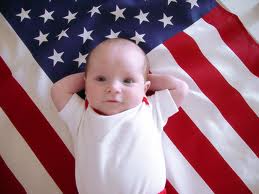

Do you love America? If so, how much? Do you wear an American flag on your lapel (and look askance on those who don’t)? Do you drive only American cars? Do you prefer home-style fries to French fries because, well, isn’t it obvious? Do you support American military operations because to do otherwise would undermine the efforts of those brave men and women who keep us free? Do you take every opportunity to express your belief that America is the best country in the history of the world?
I ask these questions in an attempt to identify an interesting phenomenon and at the same time open a discussion on the propriety of patriotism as well as its limits (assuming such exist). This discussion is especially relevant right now because as the Republican primary season drags on, the leading candidates seem anxious to demonstrate their commitment to American Exceptionalism and all that this entails. For instance, in October, Mitt Romney expressed his belief that God wants America to lead. (Unfortunately, he didn’t footnote his source). Rick Santorum asserts his faith in American Exceptionalism at his website. Newt Gingrich, along with other “conservatives” find it useful to accuse President Obama of not believing in American Exceptionalism, thus suggesting that a belief in American Exceptionalism is a fundamental doctrine in the Republican Party’s statement of faith and to deter from that, or even to appear to deter, is tantamount to heresy and worthy of excommunication. Ron Paul, I should add, seems a bit more nuanced and perhaps even a little uncomfortable speaking in terms of American Exceptionalism. But he is not typical.
Clearly, one way to express a love for one’s country is to assert that it is exceptional, that it is extraordinary. This, of course, is not quite the same as claiming that it is unique, for on some level every country is unique. The rhetoric among the true believers vying for our votes is much stronger than “America is unique place.” But with all this talk of American Exceptionalism and the assumption that those who question this doctrine hate America, it might be useful to consider a few points.
1. Love for a nation must begin with something other than the nation. In this context, it is helpful to recall the words of Edmund Burke:
To be attached to the subdivision, to love the little platoon we belong to in society, is the first principle (the germ as it were) of public affections. It is the first link in the series by which we proceed towards a love to our country and to mankind. The interests of that portion of social arrangement is a trust in the hands of all those who compose it; and as none but bad men would justify it in abuse, none but traitors would barter it away for their own personal advantage.
In other words, love naturally begins with the small, local, and personal and emanates outward from there. To profess a love for a nation without grounding that love (quite literally) in particular places and people that are intimately know, cherished, and stewarded, is to skim along the surface of love as well as responsibility. It is always easier to love an abstraction than to love a neighbor.
2. Consider the following analogy: I love my children. In fact I wouldn’t trade them for any other children in the whole wide world. Yet what if I peppered my discussion of my children with claims that they are the best children in the history of the world? What if I did this when they were around as well as when they weren’t? What if I belligerently insisted on making this claim and was offended if you disagreed? Wouldn’t that give them a strange view of the reality? Wouldn’t you find it annoying? In truth, my love for my children and commitment to them does not depend on my belief that they are the best humans the world has ever seen. True, I am delighted by them (usually) and desire the best for them. Nevertheless, my love does not depend on some notion of exceptionalism even though they are infinitely precious to me.
3. Patriotism is not the same as American Exceptionalism. Patriotism derives from the Latin pater meaning father. Patriotism is a love of the fatherland. It is an affectionate commitment to that which we have inherited. Patriotism is linked closely to the idea of piety, which points us in the direction of fidelity, responsibility, and loving care. The patriot loves with clear eyes, and because of this, can wisely work toward amending the imperfections that inevitably exist.
In a memorable passage, Burke writes the following:
No man should approach [the state] to look into its defects or corruptions but with due caution; that he should never dream of beginning it reformation by its subversion; that he should approach to the faults of the state as to the wounds of a father, with pious awe and trembling solicitude. By this wise prejudice we are taught to look with horror on those children of their country who are prompt rashly to hack that aged parent in pieces, and put him into the kettle of magicians, in hopes that by their poisonous weeds, and wild incantations, they may regenerate that paternal constitution, and renovate their father’s life.
The American Exceptionalists are the mirror image of the Jacobins, for both willingly blind themselves to reality: the one pretends there are no faults and the other that the faults are fatal. Both fail to treat the state justly.
American Exceptionalism all too often manifests itself in a blind and grating arrogance laced with jingoism. True patriotism, on the other hand, is rooted in a deep sense of gratitude, which gives birth to humility and acts of stewardship. Patriotism loves the good, though inevitably imperfect, gift we have inherited. It works with diligence and affection to improve that which is loved and to pass it on intact and perhaps even improved to the next generation. A patriot is a loving steward, continually mindful of debts to both the past and the future.
This political season, more patriotism would be a welcome (and even exceptional) change.



77 comments
robert m. peters
Mr. Stromberg,
I wanted to come to Stone Mountain; however, my son’s birthday preempted that. I grew up in the Commonwealth of Pollock in the uplands of central Louisiana in a carpetbag parish – Grant. The ultimate affront was that the river town, Calhoun’s Landing, named after a relative of John C. Calhoun, was renamed “Colfax” after one of Grant’s V.P.’s. There was a famous “riot” or “massacre” there when the militia’s of the Democratic Party took control of the parish from the militia’s of the Republican Party. Today, the Commonwealth of Pollock is, like the home to which you cannot return, being subsumed by post-modernity, primarily in the form or formless bedroom suburbs and rapid commercialization of the once scenic highways. There is no place, literally no “place” for patriots, for even the cemeteries, once unique gardens groomed with the seed of the resurrection in them, have become as innocuous as the suburbs which they serve: spaces not places, owned by corporations rather than a local idiom of the Corpus Christi, namely a country church, in which all my ancestors of the last three generations wait the Eternal Day.
Joseph Stromberg
Mr. Peters (or “Dr.,” if memory serves), I concur on the value of the Abbeville enterprise. (I had hoped you would be at the Stone Mt. event in late Feb.). My direct Southern experience, oddly enough, was in Lee County, Florida. But then again, I grew up in the eastern half of the county, which was basically an extension of Georgia. (There is an amazing overlap in names with Lee County, Georgia and the edges of Albany, which I found out driving through there.)
Mr. Sabin: Yes, that’s one of many downsides of war and conflict. Much opportunity for boodling and cost-shifting. If only we could get a generation or two in which nothing much happened, we’d have a chance of building and preserving something. But then modernism isn’t about stability; it’s about ‘dynamism’ — just ask the folks at Reason magazine. And dynamism brings me back to Florida. It’s true: you can’t go home again. They done redeveloped it. A real modern (or postmodern) ‘erasure.’
Best
D.W. Sabin
” …the small group of Virginia industrialists would have tried the same scans as the New england coal companies did”. Ho ho ho. Sectarian disputes possess a nasty habit of letting their tyrannic and exploitive elements get a place first in line. Meanwhile, the folks on the factory floor take the first bullets.
robert m. peters
Mr. Stromberg,
What I think to know about the South I learned by experience from being a Southerner for nearly sixty-three years and formally from a nest of scholars associated with “Abbeville.”
Joseph Stromberg
Mr. Jenkins,
Thanks for your reply. I suppose we shall just have to disagree on the metaphysics (so to speak) of the union.
Off the record, as it were, I sometimes think that in a Confederate Kentucky, the small group of Virginian industrialists would have tried the same scams as the New England coal companies did. Even so, “Mr. William Gregg’s coal train’s done hauled it away” would ruin the song. “Mr. Peabody” works so much better.
Fortunately for my mother’s people, they were in southern Middle Kentucky — not a coal seam in sight. Just small-scale tobacco raising and dairy farming.
Best
Siarlys Jenkins
A well thought out presentation Mr. Stromberg. I managed to come to my own conclusions as an informed citizen, without reference to Brownson, and while I once trifled with left Hegelianism, I have left it all behind. I am myself much taken with James Madison’s unsuccessful advocacy in the Constitutional Convention that the liberty of citizens should be protected from tyranny by state governments as well as the federal government. I consider the Fourteenth Amendment to be a vindication of his position.
You are of course correct about the politicians of West Virginia and Kentucky, or rather, the STATE governments in these sovereignties proved susceptible to being bought by monied interests and staying bought, a disease that secession has never cured and sometimes facilitated. Even the lower South was infatuated with nationalism during the War of 1812.
Kentucky was never going to succeed at remaining neutral, given its geographical position, and the fact that its mountains did not provide a full defensive perimeter as, e.g., Switzerland’s did during WW II. I believe your account of the order of events is accurate. Leonidas Polk moved in to Columbus, Ulysses S. Grant in Cairo notified the governor of Kentucky that the state had been invaded by confederate forces, which he would move to repel, and neutrality was over. Kentucky, like Virginia and Tennessee, contributed many soldiers to both sides, but severely disappointed Braxton Bragg when he chased Don Carlos Buell up to Perryville, expecting to arm the torrent of volunteers he expected to turn out and gladly enlist in his forces — which they did not.
robert m. peters
Mr. Stromberg,
Much of what I think to know has come under the tutelage of the scholars of Abbeville.
Joseph Stromberg
Later of course a good many *usurping* politicians in West Virginia, Kentucky, and elsewhere, decided that the chief business of a state government was to cherish, promote, and defend the operations of northeastern-owned coal companies at all costs. A sad aftermath to a fight to sustain an unreasoning form of American integral nationalism that many in the Upper South had learned in the misbegotten War of 1812.
As for states being states only in the union, the highest form of the argument is probably Orestes Brownson’s *American Republic* (1866) — a silly exercise, in my view, and one resting on a Hegelianized version of received New England unwisdom about the nature of the union, with a thin veneer of Catholicism. But it was certainly a bold attempt to cut through all the problems left over from James Madison’s “didactick federalism” (as John Taylor of Caroline called it).
As a matter of high principle, Kentucky’s initial attempt to remain neutral in the pending war made very good sense. But neither of the Big Outfits was willing to consider it. The Confederates made a brief military incursion, on strategic grounds, and the Union effectively *occupied* Kentucky in a rather hostile and partisan fashion.
Siarlys Jenkins
It is of course an interesting conundrum that newly admitted states would be in all ways equal to the original states, but that in order to obtain the status of statehood, they must submit their state constitution for approval to the federal congress. Further, the borders of territories which might apply for statehood were designated by that same congress, which could legislate for those territories until they became states, including authorizing a territorial legislature, and appointing a territorial governor.
Sam Houston was among those Texans who believed that, having sought annexation by the United States, and accepted the military protection of the United States through a major war with a neighboring nation, Texas could not and should not declare secession at will. (Texas was, of course, a third exception to the pattern that newly admitted states were formed from the national territory, but an exception that proves the rule).
It is so absurd that a state formed under federal supervision and becoming a state by permission of the federal congress could take upon itself the authority to secede, that I would submit equality with all original states strongly suggests each state forsook any right to act with complete independence and remove itself from the federal union. The rights of free travel, free trade, the nature of transportation routes, all reinforce that the very existence of the states was premised upon their federal union. So do the borders of many states, which are not designed for defensible perimeters, nor uniformly for independent access to maritime commerce.
States did retain sovereignty within the union, as innumerable Supreme Court decisions down tot he present day reaffirm. There is overlapping sovereignty, just as the Native American nations, although brought under rule of the United States by treaty or conquest, and co-existing within the territory of states of the union, retain their own distinct sovereignty.
As for President Lincoln’s action regarding Fort Sumter, he simply never recognized that any secession had occurred, and wherever possible, continued routine military functions of the national forces until they were unlawfully fired upon. Virginia, North Carolina, Tennessee, and Arkansas were indeed won over to secession only as a refusal to participate in suppressing rebellion in the cotton states… which was a very unfortunate choice. The citizens of West Virginia adopted the motto “Montani Semper Liberi” to emphasize what an unfortunate choice that was. My Tennessee ancestors took up arms against the usurping secessionist government at the first opportunity also.
Joseph Stromberg
Mr. Peters,
I wish to thank you for your stalwart efforts in the thread.
And to recur to the beginning, I have to say that Mr. Mitchell’s essay is a very good treatment of its subject.
David Smith
Rob G:
I also seem to recall something about co-equality among the states, that is, all states have neither more nor less rights (status) than the others.
Rob G
“State sovereignty”/”states rights” were perceived in the Jeffersonian understanding as being a way in which the power of the central government could be diffused. Once this understanding was jettisoned, and the states began to be seen as outposts of Washington, D.C., there was one less hindrance to the amalgamation of power by the central government. This process began in earnest during and after the Civil War, and much of it was related to the carry-0ver of Whig ideas into the new Republican party. The Whigs, of which Lincoln was one, wanted a bigger, more expansive role for the federal government. While there’s no doubt that even they would surely balk at the size and scope of government today, there’s also no doubt that it was they who got the ball rolling in that direction.
Joshua Landry
I am not sure if it is accurate to say that a State is not really a State. Twenty-six States sued the White House over the Affordable Care Act. But none of those States seceded from the Union. How could those States sue without some degree of sovereignty? Every citizen has the ballot box and every State has the courts to use if the federal government over extends itself. Every State has sovereignty without having to leave the Union, not to imply that the Union is sacred. The signers of the Constitution saw overly zealous people attaining high offices coming, and set up the entire House of Representatives to be voted on every two years as a safeguard in case less-than-desirable people should make their way into office.
Rob G
~~I derive from this fact (you might argue otherwise without denying the fact itself) that no state formed from that territory, by act of the federal congress, under the authority of the Constitution of the United States of America, was in any sense “pre-existing.” It was, de facto and de jure, a creature of the United States, having no existence outside of that union.~~
This would imply either that the “created” states had less status than the original 13, and thus could be called “states” only metaphorically, or that the original 13 were not actually states, but divisions or provinces of the federal government. Both implications seem false.
Joshua Landry
Mr. Smith,
I appreciate not only your point of view, but also those of all who added input to this discussion. Thank you.
Grace and blessings to you also,
Joshua Landry
David Smith
Mr. Landry:
Thank you, sir, for your gracious response, even though may continue in our disagreement.
Grace and blessings,
David Smith
Joshua Landry
Mr. Smith, I do admit that my memory had failed me about Lincoln attempting to resupply Fort Sumter in 1861, though I don’t think the supplies ever made it.
Joshua Landry
My folk in Florida seceded as well. I still believe that in the end, the outcome, the ending of slavery, was the right outcome. The indivisible idea brought along the end of slavery. The idea of States’ rights would have perpetuated it. I don’t see how slavery can justify an idea.
David Smith
Mr. Landry:
Delegations were sent to D.C. from the new Confederacy in order to negotiate future relations, trade, and even repayment for federal forts within the South, I believe. Lincoln as good as admitted that he provoked the firing on Sumter, as I recall, with the resupply of the installation after they had been asked to leave (Blind-sided?!?). On the more local scale, I would no more allow an armed stranger to remain on my front porch today than the South Carolinians were willing to allow a foreign power to maintain its base on theirs. That’s just silly.
Besides, the fiction of the garrison at Sumter being there in order to protect the local citizenry, considering the circumstances, was long past its expiration date, even then. That notion would be as laughable then as it is now.
And, by the way, it was not until Lincoln made his outrageous and unconstitutional demand for 75,000 volunteers from the remaining states in order to put down the “rebellion” that my folk here in Tennessee seceded, along with Virginia, NC, and Arkansas.
Again, you seem to struggle with the flawed notion of the Union as INDIVISIBLE, something the ratifiers would have found nonsensical. “State” in 18th c. parlance is synonymous with “nation”, and is not a mere administrative province of a now centralized government. At any rate, foreigners is therefore indeed a fitting description.
Siarlys Jenkins
Mr. Smith, it is well known that any argument can be continued ad infinitum without discernible resolution so long as each side propounds mutually inconsistent premises as “the facts” and accuses the other of “ignoring” these “facts.”
It is a matter upon which reasonable minds might disagree WHETHER the original signators to, and ratifiers of, the Constitution of the United States of America intended to reserve a right to secede from the union entered into. It is certainly not specified in the document. Much of the debate at the time suggests that men (and a few women, even then) were concerned about the powers being delegated to the federal government precisely BECAUSE it would no longer be such an easy deal to pull out of as the Confederation. Madison emphasize, in his contributions to The Federalist Papers, that the federal government would act directly upon, and be acted directly upon by, the citizens of all the states; it would not, as the Confederation did, act only THROUGH the separate states. Having considered these arguments, representatives of each state duly ratified the document, thus authorizing the new federal government to come into existence.
While the argument that superiors delegate to subordinates is plausible, the constitution was also a compact with every other state to adhere to a mutually advantageous permanent union. Contract law along denies the right of any party to reap the benefits during four score and seven years, then abscond at will to the disadvantage of other contracting parties when it seems convenient.
Most of the states that “seceded” were not “pre-existing” states. Initially, only South Carolina and Georgia could make that claim. (Initially, Virginia and North Carolina had no intention of seceding). I assert as FACT that every state not among the original 13, with the exceptions of Maine and Vermont, were formed from territory of the United States, as a whole, to which every one of the original 13 states relinquished individual claims, in favor of the United States. Dispute this fact if you can.
IF this is a FACT, I derive from this fact (you might argue otherwise without denying the fact itself) that no state formed from that territory, by act of the federal congress, under the authority of the Constitution of the United States of America, was in any sense “pre-existing.” It was, de facto and de jure, a creature of the United States, having no existence outside of that union.
I yield nothing to you sir, in honoring the gallant resistance of MY hillbilly ancestors to tyranny… first, of the British, then, of the faux aristocrats of the purported Confederacy. Did you overlook the areas of the south I highlighted, where loyalty to the union was most intense? Mountain country, every bit of it. I have read, but know less in detail, that similar sentiments persisted in the Ozarks. Did you miss that my great-great-grandfather was from eastern Tennessee, the Cumberland Plateau? They lie who call the conflict of 1861-1865 a “war between the states.” It was truly a CIVIL WAR, albeit each party to the war achieved dominance in some parts of the national geography over adherents of the other party in those same areas.
Joshua Landry
Mr. Smith, you said, “My “hill billy” ancestors who fought because their homes were being invaded by foreigners. . .” I must say, the first shot of the Civil War was fired at Fort Sumter by the future Confederacy. Before the war, United States military personnel manned Fort Sumter as part of President Madison’s plan to protect the Eastern Seaboard from invasion. After South Carolina seceded from the Union, the soldiers loyal to South Carolina rather than the Union turned on the troops stationed at Fort Sumter for the protection of the local residents, and bombarded the Fort until the blind-sided troops within the Fort surrendered. The fighting would continue throughout with the nations with the Union being on the defensive. The Confederacy was not invaded by foreigners; the Confederacy made itself the foreigner.
David Smith
Mr. Peters:
I am as enlightened, as usual, by your comments as I am by this fine article. Thank you, sir!
Mr. Jenkins:
Your words: “While the argument is faintly plausible that Virginia, North Carolina, South Carolina and Georgia had a right to revoke their ratification of the Constitution of the United States of America, as to all other states, they existed AS states only within the framework of that constitution, and by consent of the federal congress. If that connection ceased, the land on which they existed reverted to the status of federal territory. The romantic notions of some great and glorious cause which tip-toe delicately around all these facts are so much humbug.”
Have you entirely ingnored the historical facts? As Mr. Peters pointed out, no state, including those in favor of stronger central control, would have ratified the Constitution if they had thought they were surrendering their sovereignty. They existed only as states within the framework of the Constitution?!!? With all due respect, I’m afraid the only “humbug” is your assertion. It appears that you are manufacturing “facts” ex nihilo, or perhaps you’re engaging in interpretive contortions to make such an assertion. In any event, it is demonstrably false, and I’m afraid you simply refuse to acknowledge it. The states pre-existed, created, and delegated powers to the federal government; superiors delegate to subordinates. They would have continued on were they not victims of conquest and the eventual 19th c. version of nation building (aka Reconstruction).
No government, including the old and flawed CSA, deserves any form of worship. My “hill billy” ancestors who fought because their homes were being invaded by foreigners would be scandalized by any assertion that they were merely cowed lackeys fighting for the rights of those in the “Big House” or in Richmond to keep their slaves or anything else. Traditionally, and at our best, we Southerners were a collection of extended families, fighting for kith and kin, for stakes that were existentially vital to us, not some abstraction like “making the world safe for democracy” or “American Exceptionalism”.
Siarlys Jenkins
Do you love America? Yes.
If so, how much? Not quantifiable.
Do you wear an American flag on your lapel (and look askance on those who don’t)? No, and no.
Do you drive only American cars? No, I drive a Kia, because it gets better gas mileage than any other car I could afford, costing 40% the price of a Prius, which isn’t an American car either.
Do you prefer home-style fries to French fries because, well, isn’t it obvious? No, I love French Fries, as long as there is plenty of ketchup to dip them in.
Do you support American military operations because to do otherwise would undermine the efforts of those brave men and women who keep us free? No, I honor those who took the brunt of whatever our elected government is doing, in our name, and on our behalf, but I’d rather bring them all home if the mission isn’t worth what they are being asked to sacrifice.
Do you take every opportunity to express your belief that America is the best country in the history of the world? No, because that can be easily misinterpreted.
Then the discussion seemed to transition from is the USA the best country in the world to was the misbegotten cabal that styled itself the CSA the best country in the world.
“The South” did not secede from the United States. Certain designing men assembled conventions which declared in the Name of the People of certain states that those states were removing themselves from the United States. Objections were particularly notable in western North Carolina, western Virginia, eastern Tennessee (from which one of my ancestors enlisted in the 11th Tennessee Cavalry, United States Army), northern Georgia, Jones County, Mississippi… Confederate newspaper editors excoriated early in the war what a shame it was that insufficient manpower had volunteered to fight for southern independence… the cabal that styled itself the government of the Confederate States of America had to institute conscription a year before the federal government did so, and still had to deal with a high desertion rate, and the propensity of governors and judges to issue all kinds of writs protecting thousands from being drafted. In fact, Jefferson Davis could only make war by trampling on “states rights,” which he lamented by writing as the CSA’s epitaph “Died of a theory.”
The Constitution of the Confederate States of America differed from the Constitution of the United States of America primarily in that a clause was added to provide that “the institution of Negro slavery” should not be interfered with. This is hardly a proud difference to hang out as an inspirational banner. While the argument is faintly plausible that Virginia, North Carolina, South Carolina and Georgia had a right to revoke their ratification of the Constitution of the United States of America, as to all other states, they existed AS states only within the framework of that constitution, and by consent of the federal congress. If that connection ceased, the land on which they existed reverted to the status of federal territory. The romantic notions of some great and glorious cause which tip-toe delicately around all these facts are so much humbug.
Father Jonathan
I realize I’m late to the party, but I have to say that I find this article fascinating. I’m particularly interested in this:
“In other words, love naturally begins with the small, local, and personal and emanates outward from there. To profess a love for a nation without grounding that love (quite literally) in particular places and people that are intimately know, cherished, and stewarded, is to skim along the surface of love as well as responsibility. It is always easier to love an abstraction than to love a neighbor.”
I’m particularly interested in how something like this translates to the realm of the Church. Forgive me if this has already been said in the discussion above, but I wonder how we come to love the Church without personal experience of her. This is why the ancient idea of dioceses and parishes is so grand, not because scripture commands it (which it doesn’t), but because it gives us a sense of place, a sense of local connection to universal mystery. But for a lot of folks today, that local connection is impoverished, whether because they are part of an ancient Church like the Roman or Orthodox or Anglican but they have been invested more in the Church concept than the Church as an incarnate phenomenon, or because they have been branded by the dizzying experience of modern American mega-church worship, which always feels to me like McDonalds style ecclesiology.
Anyway, that is a very scattered thought, and not really on topic, but you’ve got me thinking!
robert m. peters
Mr. Landry,
I was once the thrall of the Hobbesian ideology. It has taken me near twenty years of struggle with the help of some wonderful mentors to break the collar; or to use an entirely different metaphor, to exorcise the demon. Thereafter one sees with different eyes.
Romans 13 was certainly not understood by the catacombed Church to give carte blanche to Caesar, nor should the Church in post-modernity give “Caesar” carte blanche.
Voting is not a divine right; it is not a natural right, whatever that is; it is not a human right, whatever that is. Christian kingdoms, Christian principalities, Christian republics and Christian free cities existed and flourished without voter enfranchisement as it understood in Modernity.
Mexico was not attempting to take away the “right to vote” in our war with it; the Confederacy was not trying to take away the “right to vote” in your war with us; Spain was not trying to take away the “right to vote” in our war with Spain; the Kaiser’s Germany was certainly not trying to take away our “right to vote;” taking the “right to vote” from Americans was not high on Hitler’s list of priorities nor on Tojo’s – they had other fish to fry and were trying, in the end, to avoid being fried; North Korea and China were not trying to take our “right to vote.” The list could go on.
The profession of soldier is an honorable one, much more honorable than the profession of the politician. Let us not, however, dishonor their sacrifices – death, being maimed, becoming creatures of war, divorce, broken minds – with false “noble causes.” One of the first duties of a good Christian and a good citizen is to emancipate himself from the false causes which “leaders” claim when sending men to war for nefarious reasons. Polk, Lincoln, McKinley, Wilson, Roosevelt, Truman, Kennedy, Bush I, Clinton, Bush II and Obama have not sent men to war to protect the right to vote.
People had the “right to vote” in Nazi Germany and in the Soviet Union; the difference between their “system” and ours now is that the elites who ran the show in those countries were not two-faced, Janus-faced, two-heads – Democrat and Republican – of the same monster.
Trent Demarest
It’s only called the American Revolution because the erstwhile-colonists won. It would probably be termed the American Colonial Rebellion if they hadn’t. And, please, don’t anyone trot out the divine-determinist claptrap that God wanted the colonists to win. Also, it should be remembered that the colonists fought first for representation in Parliament per their rights as Englishmen (this was an English political dispute, hence Whigs vs. Tories); the goal did eventually become independence, but it did not start out that way. Pauline Maier’s America Scripture does an excellent job of tracing the history of the conflict prior to the Declaration of Independence.
Mr. Peters, I see that there is no option to email me from my Plus profile. If you would do me the courtesy of contacting me via tddemarest at gmail dot com, I would be most appreciative. I use this address for impersonal stuff, but will fish out your email and contact you via my regular address.
Joshua Landry
“And for the support of this Declaration, with a firm reliance on the protection of divine Providence, we mutually pledge to each other our Lives, our Fortunes and our sacred Honor” — Declaration of Independence.
Sounds like the group of men fondly remembered as the “founding fathers” put a great deal of thought into such a simple “experiment.” Considering that “taxation without representation” was one reason for the American Revolution, I find it hard to see how none of the deaths of U.S. soldiers and militia have not been for the privilege of voting. Also, unless I am mistaken, the people of Iraq have been very appreciative of the opportunity to vote. To have any voice in the workings of government is a privilege.
What does Caesar own? That which God gives him. Romans 13:1 says that there is no authority that God does not put in place, and that God appoints the authorities.
John Haas
Mr. peters, quoting: “… the powers granted under the Constitution being derived from the People of the United States may be resumed by them …”
I suppose that’s true …
So, feeling disempowered, People? Worried you’re just a fluoride-medicated serf on a giant technopolized collective farm called Oceania (which has, of course, always been at war with Eurasia)?
Join me then! Step out on the porch and let’s all proclaim at once, “We the People hereby resume our Powers!”
All right, then. So, what’s next?
Trent Demarest
Mr. Peters,
I have found what you have written here to be quite compelling, and expressive of views that I, too, hold, yet have not been able to express as you have, especially that last bit about living in communion with God and family in the small places He has deigned to put us. I should like to keep in touch with you outside the confines of the comment feed. If you click on my name the link will take you to my blog. My Google + profile is visible there (yes, terrible, I know). There is an option on my profile to send me an email. I’d appreciate it if you did.
Thanks once again for making your stand for Dixie. She does live on, despite her status as a pariah and America’s “internal Orient”. A time is coming when I think more will wish we hadn’t become slaves of industry and expansion, that we hadn’t ballooned into “a cast cuttlefish of dominion with a tentacle in every orifice of the body politic”, that we hadn’t become the thralls of transnational corporate interests. I think the humane vision of those like yourself, along with the good people who keep this site (the good Dr. Mark Mitchell not least among them), Wendell Berry, Allan Carlson, et al, will continue to resonate. Who cares if it becomes a movement? It’s a culture that we can keep, that we can live.
God bless.
TD
robert m. peters
Mr. Landry,
The Union was not sacred. The generation of Americans of the 18th century knew that, at best, it was an experiment. It failed. The South did not rend the Union. The Union could have continued to exist quite nicely without the South. Jefferson, in fact, envisioned at least five separate American union on the territory of the North American Continent. In addition, he envisioned that as states got too big in population to remain true republics, they would naturally divide into other republics or ward republics. Thus was Kentucky born of Virginia; Tennessee was born of North Carolina; the Northwest Territory was born of Virginia. The Union no longer exists, so that is actually all a mute point.
I am not in the least sure that the deaths of soldiers in any of the wars in which Americans have been hurled have been so that we can elect our leaders; and I am not in the least sure that electing our leaders is such a “noble cause.”
“The Earth is the Lord’s and the fullness thereof.” What then does Caesar actually own? One should never let the propaganda use of a biblical passage by men eager to cover their bid for raw power with a moral cloak override the ultimate irony in the words which our Lord used on the Pharisees to snap the trap shut on them, the trap that they thought to have set against him! A Christians in the true spirit of Romans 13 indeed has a hierarchical duty: first to the God, then to his father, then to his pastor and then to his sheriff. The President is a long way down the chain.
As Christians, it is first our responsibility to learn to live creaturely in the real created order and not to be fooled by the lies, fictions and myths of abstract ideologies and philosophies.
Joshua Landry
I would like to mention, Mr. Peters, sir, that during the time of the American Revolution, we had no ballot box. Our only option was war. Later on, in 1860, the Democratic Party was split down the middle, and Abraham Lincoln won the election. The South was unhappy with the election results. But, instead of waiting for the midterm election, they decided to simply rend the Union apart. Our current political parties have flaws, no doubt. In response, enter the TEA Party. However, simply because the options available today might not be ideal does not mean that the process of free elections is faulty. Too many of our bravest men and women gave their lives so that we could elect our leaders. With no offense intended to you, sir, my belief is that simply pointing fingers at the problems serves to duck away form the responsibilities that we do have to our nation. Jesus said, “Render unto Caesar the things that are Caesar’s, and unto God the things that are God’s.” As Christians, we have a responsibility to God and to government. It is a privilege to have the ballot box as a remedy for the evils in government. It is our responsibility to use it.
robert m. peters
Mr. Landry,
When two factions, the Democratic Party and the Republican party, often financed and animated by the same set of elites determine the candidates from whom you must chose, how do you see the “vote” as a remedy?
Secession, rightly done, is an alternative to rebellion. Of course, if a faction controls the means of coercion and the purse, that faction can crush any attempt at peaceful secession and will usually do it under the color of “law” and in the guise of a “noble cause.” The same “spirit” which crushed secession in America now reaches out to preemptively crush the attempts of sovereign nations such as Serbia, Iraq, Lybia, and Egypt and likely Syria and Iran to exist outside the ever encroaching “new order” with its notions of human rights and promoting democracy.
Secession is in our blood. We seceded from the British Crown which chose war rather than peace; we seceded from the union under our own articles of Confederation and did so peacefully; some of us seceded, again questing for peace, in 1860/61. The majority faction decided war was better than peace. Secession remains a legitimate option; but it is not now and likely will not be a prudent option. The best option is to forget secession and to forget voting; it is to learn to care for, creaturely and Christianly, the reduced realm over which you do retain a modicum or authority: love your spouse, nurture and care for your children and other kith and kin, tend to the hearth, honor blood and earth where you can, honor your parents in the way you live, edify the Church, and glorify your Lord.
Keep the sacred places: the marriage bed between husband and wife; the supper table as a place of the vesper for the family; the communion table for the Christ and His bride, and the gardens – the flower garden for beauty, the vegetable garden for nourishment and the cemetery as that garden of our final baptism, buried with Him in baptism to be in That Day raised with Him to walk in newness of life. Keep in mind that the highest blessing in the Beatitudes is to be persecuted for the Christ.
To dwell on these things and to do them will serve far better than voting and secession.
You might also remember that we live in a created order, and that the Creator of that order and only the Creator of that order is sovereign. We should never confuse delegated authority held in stewardship with sovereignty; for only God is sovereign. So at the core of things, individuals do not have sovereignty, commonwealths do not have sovereignty, and nation-states and empires do not have sovereignty. As much as I use “sovereignty” to defend the authority of a commonwealth, dominion or state against an encroaching and usurping general government or Hobbesian Leviathan, in the end the notion of sovereignty is a blasphemy against God, for sovereignty denotes an “independent authority,” and in a created order, there is no authority independent of the Creator.
robert m. peters
Mr. Haas,
Your words:
“They were incorporated, by the way, through special conventions of the people, not by the state legislatures themselves. That far-from-minor fact is the starting point for any discussion of the status and priveleges of the states.)”
The legislatures of a given state are not the state; the people of a particular state, dominion, commonwealth or republic, including the traditions, customs and habits thereof, are the state, and as such each state ratified the Constitution. It has, however, nothing to do with a majority of people. You have simply, agreeing with me in a previous post, defined what a state is. You have not made your case; you have, in fact, made mine; for the state is its unique social order, i.e. people, and the people in convention ratify, nullify and secede.
The people of Virginia, in ratifying the Constitution, said the following:
“Do in the name and in behalf of the People of Virginia declare and make known that the powers granted under the Constitution being derived from the People of the United States may be resumed by them whensoever the same shall be perverted to their injury or oppression and that every power not granted thereby remains with them and at their will.”
They make it clear that in their very ratification is the authority to resume the powers granted if those powers shall be perverted to their injury.
In its ratification, Rhode Island states:
“That the powers of government may be reassumed by the people whensoever it shall become necessary to their happiness.”
Joshua Landry
I must say that I believe that the best remedy, instead of succession, which could be looked at as running away from a problem, would be the ballot box. From 2009 to 2011, the 111th Congress epitomized the notion of an over- bloated government train wreck. In response, the rightly aggravated electorate took their frustrations to the ballot box, and gave the Republican Party their biggest take-back of the House of Representatives since F.D.R. was President. (I am not implying that the GOP is the savior of the nation) I personally believe that that is a better solution than succession on the belief of State sovereignty. Every citizen does have some degree of duty to the nation as a whole.
Thank you, gentlemen, for your insights.
D.W. Sabin
Would that we might possess a Burke now, when we need him most. The simple fact of the matter is that the Unites States of America truly is an exceptional country. Despite our lapses, we seem to be anointed by God, as Churchill asserted, along with drunks.We should do better by this dispensation.
Our sense of exceptionalism is frequently co-opted by the State- Media combine to mean that exceptionalism means we can do no wrong. A nation devoid of critical self-appraisal is a nation engaged in active fraud. We are within a period of real societal flux, an historical period and the best we can do is a Republican Primary of serial platitudes prior to the ultimate match-up of Centrist Platitudes between the prevailing political parties.
John Haas
Mr. Landry, the question of states and their status in a federal union is an immensely complex one. Many readers of this blog, eg, would argue that styate governments are more responsive to their citizenries, more likely to support distinctive values, less over-bearing, wasteful, belligerent, and so forth.
For some, the possibility of secession is necessary to protect what they believe is the right of a state to nullify federal legislation a state may object to. They believe that that right is necessary if a state is to retain its dual function of promoting distinctive local cultures and values and resisting the totalizing, homogenizing tendencies of the national government, with its agencies, bureaucracies, powers of coercion and so forth.
Others, while admitting these aspects of the relationship, also take into account the historical record (as you’ve alluded), which involves states oppressing various minorities (racial, religious) or disempowered classes. They would argue that the abuses of the national government are a risk we need to run to avoid the injustices perpetrated by local elites, and that, as long as the government remains open to democratic correction, the risk is worth it.
Pick, in other words, your poison.
A good place to start in reflecting on these matters would be the relevant chapters of Alexis de Tocqueville’s classic, “Democracy in America.”
Joshua Landry
One final question to you gentlemen: what is so vital about the idea of State sovereignty? The strong belief in State sovereignty lead the Confederacy to defend the institution of slavery after the Emancipation Proclamation of 1863. It seems to me that State sovereignty can be dangerous.
John Haas
Mr. peters’s various assurances, speculations and prejudices notwithstanding, he remains very confused.
As shown above, the states surrendered their sovereignty–ie, totalcontrol–when they were incorporated into the United States of America as defined by the Constitution.
(They were incorporated, by the way, through special conventions of the people, not by the state legislatures themselves. That far-from-minor fact is the starting point for any discussion of the status and priveleges of the states.)
This loss of sovereignty is evident throughout the Constitution, from the preamble, to the powers of the executive and the judiciary, to the unlimited (!) power of Congress to “levy taxes.”
This loss of state sovereignty is most obviously evident in the already-cited Article VI, which bears repeating as it affects Mr. peters misunderstandings regarding secession: The Constitution, it is asserted, including any amendations that might be performed on it, “shall be the supreme Law of the Land; and the Judges in every State shall be bound thereby, any Thing in the Constitution or Laws of any State to the Contrary notwithstanding.”
Most obviously, this is a blanket reversal of the Articles’ assertion that any alterations must not only “be agreed to in a Congress of the United States,” but also, and most importantly, “be afterwards confirmed by the legislatures of every State.”
Thus, the law of the land of, say, South Carolina, can now, under the Constitution, be altered, without South Carolina’s consent. Mr.peters’s seems either incapable of understanding the profound implications of this fact, or, understanding but not liking it, he simply continues to insist that it is not the case. A plain reading of the texts in question to the contrary. Let this suffice to clear up Mr. Lamdry’s misunderstandings also.
Not understanding the changed status of the states under the Constitution leads Mr. peters to completely misunderstand the question of secession. He fails, first, to distinguish between different responses a state (or, forthat matter, and individual–since states and individuals are in fact in parallel positions regarding delegated powers and retained rights) might offer to the national government.
As Article VI says, federal laws and Constitutional amendments and the rest are the law of the land “any Thing in the Constitution or Laws of any State to the Contrary notwithstanding.”
What does this mean? It means, for instance, that as of his inauguration in 1861, Abraham Lincoln was the president of the US, and he was in South Carolina as much as he was in Ohio. Objecting to the decision of the 1860 election, what recourse had South Carolina? They could legally secede from the Union–that would have required not only passage of such legislation in South Carolina, but also in the Congress of the United States (South Carolina being, until that point, obviously a part of the United States). Or, failing that, there is always the ancient right of revolution (which, of course, needs to be made good, usually through force of arms, as nations are generally not predisposed to the loss of territory, natural resources, or popluation against their will).
But no state may unilaterally void its membership in the United States of America any more than a foreign power could simply assert sovereignty over territory and population of the United States. In the same way, no individual is allowed to unilaterally declare his or her sovereignty and flout federal law. All of these limitations are simply entailed by the mere fact of being a nation.
robert m. peters
Mr. Landry,
Your question – What is a state without people?” – is an excellent one. It goes to the difference between patriotism and Hobbesianism, in its nationalist and its globalist forms.
Our colonial ancestors and not merely those who have been placed in the pantheon of “the founders,” a notion which we need to emancipate ourselves from, so the thirteen respective social orders as republics, dominions or commonwealths, each with unique traditions, customs and habits which they cherished and jealously guarded. Each of these social orders with their people in communion around unique traditions, customs and habits constituted a state.
What the 18th century social order which used the title state, but also republic, dominion or commonwealth, was a special community. At “state” in that context was not an abstraction; it was not the constitution thereof; it was not the government thereof; it was not the bureaucracy thereof; it was not even the aggregate of individuals within the boundaries thereof; it was the people thereof in communion around recognized and lived out traditions, customs and habits uniquely associated with them. Politically, the sovereignty of a “state” so understood existed only when the people thereof for some very important purpose gathered in communal assembly or conventions to decide an issue – ratification, nullification, secession – which would concern the entire body, although the entire body was not assemble.
Our minds have been numbed by the Hobbesian abstraction and by the atomization of the communion life of the local, which includes the “state” as the colonial generation and later generations, at least up until 1865 understood it, that we can now only think of “people” as estranged, alienated and shriveled selves, with the more daring of them falsely believing that they are Promethean selves, and we can only think of them in the collective, strutting around with their individual rights and their one-man-one-vote. We have becomes Hobbes’ mass or collective of autonomous individuals who need protection from one another, the summum malum, by his consolidated and centralized Leviathan. This is precisely what Jefferson Davis understood when he gave his speech in 1862 to the Mississippi legislature: our enemies were (had become) a nation of strangers, while we remain (for a fleeting and passing time) a people of sentiments.
There is no doubt that the 14th amendment, the Hobbesian amendment, which is by any objective standard unconstitutional in that it was unconstitutionally ratified, stood the Constitution on its head. The Constitution as originally ratified created for the states a general government to do certain delegated tasks for the states, and the Constitution was the lawful chains to protect the states and the people thereof from the usurpation by that general government were it to so attempt. The 14th amendment, stripped the states of their power, and created a aggregate of people whose protector, much like a mobster is a protector of a neighborhood, became the general government which by the 14th amendment morphed into a Hobbesian Leviathan. It was the ultimate victory of the Hobbesian over the Aristotelian understanding of social and political order.
All of this is best articulated in the greatest but now totally forgotten American political philosopher John C. Calhoun.
robert m. peters
Mr. Landry,
I am sure that you are aware that the line “we the people” was inserted into the Constitution by the committee on style in its last review because in that committee the question was raised about the wording which the committee had received from the body. That wording listed all of the sovereign states. The concern was that since the states were sovereign, their names could not be placed in a document which the states had not yet seen and had not yet voted on. The committee operated with the presupposition that some of the states would not even ratify the document. When the committee’s new wording came out, it was completely understood and was not even challenged by the most radical anti-federalist among the delegates.
The process of ratification best tells the story. The Constitution was not ratified by an aggregate of people but by each individual state. It became a lawful compact for those so ratifying when nine of the states had ratified. States which had not ratified after the compact went into effect were considered foreign powers. Virginia, the linchpin state, ratified with the caveat in her ratification document that she retained the sovereign authority to leave the compact at will. At least one other state had similar wording in the ratification document.
Over the years, I have read excerpts or entire records of the ratification process in each state. I assure you, based on what was recorded in each of those sets of documents, that no state, not even a state with a strong federalist tendency, would have ratified the Constitution if the delegates there in convention assembled had believe that the Constitution was what Mr. Haas has represented it to be. We must remember that the Constitution’ sole source of authority lies with the ratification thereof by the states. It has no other source of authority.
Joshua Landry
Mr. Haas, I would imagine that you have a point. At the same time, I know of no sovereignty, state or federal, that does not come from “We the people.” To quote the Preamble to the Constitution, “We the people of the United States,. . ., do ordain and establish this Constitution for the United States of America.” The States still retained their full sovereignty apart from the federal Constitution until July 9th, 1868 when the Fourteenth Amendment was ratified. At the same time, that was still at the consent of “We the people” of the individual States. No Amendment can be ratified without the consent of two-thirds of the States. You mention the “States” and “the people” as completely separate bodies. May I request that you clarify that idea? What is a State without people?
robert m. peters
Mr. Haas,
I can assure you that I am not confused.
No, in so far, you are quite correct. The Constitution cannot be amended save by a three fourths of the legislature of the states or by three fourths of the legislatures thereof. Your argument goes lame, however, because no where in the Constitution do the states prohibit themselves from leaving the Union, with the Constitution thereof left unamended for the states which choose to remain in the Union. Secession is not an amendment of the Constitution by a state. It is merely voluntarily seceding from a compact to which it voluntarily seceded. When the Cotton States seceded from the Union, they did not change one dot or tittle of the Constitution, of the general government of the United States, or of the relationship of the states remaining in the Union.
Federal law, which is not to be confused with the Constitution, is the supreme law of the land as long as that law is constitutional. When it is unconstitutional, it is not the supreme law of the land.
Where do you get your line – “delegation of powers has occurred – but not by the states-rather by the people”? Just what binding document are you quoting?
John Haas
pb: sorry, a clause got lost there; hopefully obviously, given AC XIII (and my larger contrast of the Articles with the Constitution), what I intended was “the fundamental law of the land cannot be altered (amended) without the agreement of each state Having your laws changed without your agreement is not congruent with sovereignty.”
Here I take it you are refering to the US Constitution, not the Articles: “Laws made by the Congress are valid because that power has been delegated to it by the States. It will be said that this does not mean that the States have given up Sovereignty; merely that they have delegated certain powers to the Federal Government.”
Delegation of powers has occurred, but not by the states–rather by the people.
Sovereignty of the states has been given up. The fundamental law of the land–the Constitution itself–can be altered without the agreement of a state (and it is then the supreme law, over-riding any state’s laws or state constitution). If someone wants to call that “sovereignty” they will need to come up with a qualifier of some kind: “over-ridable sovereignty” or “meaningless sovereignty” or “sovereignty of the fictitious kind indulged only by fantasists besotted by dreams of past glories that never were,” perhaps.
pb
John Haas:
The Articles declare the states to be sovereign; in keeping with that status, the fundamental law of the land cannot be altered (amended).
From your own post:
AC XIII: “… nor shall any alteration at any time hereafter be made in any of them; unless such alteration be agreed to in a Congress of the United States, and be afterwards confirmed by the legislatures of every State.”
Laws made by the Congress are valid because that power has been delegated to it by the States. It will be said that this does not mean that the States have given up Sovereignty; merely that they have delegated certain powers to the Federal Government.
Rob G
“My point with FDR was that the nascent Hobbesian Leviathan which emerged under Lincoln reached its full power under the New Deal.”
Not that I agree with them, but some conservatives of a more “neo” stripe will argue that Leviathan was hatched not under Lincoln, but under Wilson. Seems to me, however, that it did indeed emerge under Abe and then was incubated by Woodrow.
John Haas
Mr. peters is, unsurprisingly, deeply confused regarding the nature of our Constitution, and the status of the states under it. Note the following four quotations. the first two are from “The Articles of Confederation and Perpetual Union,” the next two from the US Constitution.
AC II: “Each state retains its sovereignty, freedom, and independence, and every power, jurisdiction, and right, which is not by this Confederation expressly delegated to the United States, in Congress assembled. ”
AC XIII: “… nor shall any alteration at any time hereafter be made in any of them; unless such alteration be agreed to in a Congress of the United States, and be afterwards confirmed by the legislatures of every State.”
USC V: “… Amendments to this Constitution … shall be valid to all Intents and Purposes, as part of this Constitution, when ratified by the Legislatures of three fourths of the several States, or by Conventions in three fourths thereof …”
USC VI: “This Constitution, and the Laws of the United States which shall be made in Pursuance thereof; and all Treaties made, or which shall be made, under the Authority of the United States, shall be the supreme Law of the Land; and the Judges in every State shall be bound thereby, any Thing in the Constitution or Laws of any State to the Contrary notwithstanding.”
The Articles declare the states to be sovereign; in keeping with that status, the fundamental law of the land cannot be altered (amended). Having your laws changed without your agreement is not congruent with sovereignty.
Note how different the regime is under the Constitution. Fundamentallaw here can–and is–changed without the consent of each of the states. How can this be? Clearly, they are not sovereign. Sovereignty has been surrendered. Indeed, you will note, if you would like to read the entire Constitution, that the declaration of soverignty in the Articles, article II, is not retained.
robert m. peters
JF311
Your words:
“Lincoln did not destroy the Union. He put down a rebellion, as he was empowered by the Constitution to do. Can you really imagine a government that has no power to deal with those who flout its laws and seek its overthrow?”
What rebellion? What constitutional power? Who were the sovereigns who had created the general government for their benefit and for the benefit of their unique and respective citizens and residents? No laws were flouted! No one intended, plotted or attempted to overthrow any government?
robert m. peters
Mr. Walsh,
The Spanish American War was the beginning for the foreign phase of Hobbesian imperialism, placing us on a collision course, ultimately, with another emerging empire, the Empire of Japan.
The “defrocked” Baptist preacher, Francis Bellamy, the avowed socialist of a nationalist ilk did indeed push his Jacobin pledge through the NEA. It, however, did not make it into the schools in our climes until WWII, according the the old timers through the 4-H Club which introduced it.
My point with FDR was that the nascent Hobbesian Leviathan which emerged under Lincoln reached its full power under the New Deal. Indeed, the last Jeffersonian President who attempted to stay the monster was Grover Cleveland. With the coming of the Republicans to power under McKinley, Cleveland’s stop gap was overwhelmed and crushed – on to Cuba, on to the Philippines, with the that the game table was set for Roosevelt and his intrigues with the Japanese.
dave walsh
Well, robert peters, in my mind the climax was the Spanish American War, not FDR’s New Deal. And in fact, I’d say FDR was a response to unfettered capitalism, he warping the government surely, but an effect, not an intent.
I’m probably wrong, and I suppose all I’m doing is desparing of our imperialism and picking what seems to me to be the threshold and saying – that’s it. That’s when they started saying the Pledge of Allegiance.
robert m. peters
Mr. Landry,
God blesses many nations, and we creatures are not in the position, given our ignorance as mere creatures and then as mere creatures fallen, to determine how God may have blessed a given country.
If we interpret our perception of God’s blessing to mean that we are exceptional, then we make God’s blessing into an idol and turn good into evil. Blessings, assuming that we are blessed and that we can even accurately recognize our blessings, should be received with humility and should not be construed to mean that we are thereby empowered to remake the world in our image by carrying out a Western or American version of the Brezhnev Doctrine – making the world safe for democracy, promoting human rights, etc., particularly when we do it with bombs and with fiat currency.
Below is a copy of the Brezhnev Doctrine:
“When forces that are hostile to socialism try to turn the development of some socialist country towards capitalism, it becomes not only a problem of the country concerned, but a common problem and concern of all socialist countries.”
http://www.chroniclesmagazine.org/2008/08/21/the-brezhnev-doctrine-alive-and-well/
Simply substitute “democracy” for “socialism” and some term such as “repressive regime” for “capitalism” and you have our version of the doctrine by which several hostile and bloody Soviet actions were justified.
As to your final question, Lincoln, of course, did not recognize the sovereignty of any state, including those in the original Union, much less those which had seceded and had formed their own union of constitutionally federated republics. Your question, however, raises an excellent point. Lincoln’s proclamation “freed” only those slaves in states still in “rebellion.” It “freed” no slaves in states remaining in the union. In Louisiana as well as in other Southern states, one had the ironic situation that slaves in Union controlled parts of Louisiana were not “freed” and slaves in Confederate controlled Louisiana were “freed.” Many of the slaves in Union controlled Louisiana were placed as slaves in contraband camps in which hundreds of them died. As confiscated property, they were considered contraband of war.
Comments are closed.