

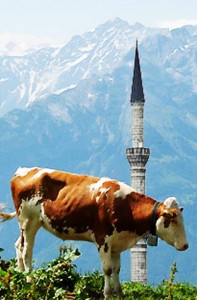
Often the politics of the local turns on the “who” as much as the “where.”
Switzerland showed as much very recently. The country enjoys some goodwill among the sort of people who read FPR. It is one of the world’s oldest democracies, and by most standards, the most direct one. Its citizens traipse to the polls several times a year to vote on federal, cantonal, and local referenda. The country’s strong civic ethos and attachment to direct participation and local self-government have largely survived economic development, and have been one bulwark against entry to what many see as a top-heavy European Union.
Two weeks ago, Swiss direct democracy got the world’s attention in a more dubious way. Some 57% of its voters approved an initiative to ban the building of new minarets. To some, the controversy seemed like a tempest in a teacup, since there are only four minarets in the whole country. But the referendum became a symbol of ever more pronounced tensions over national identity, tolerance, and the place of Muslim and other immigrants.
From the cafes of liberal Geneva to the newsrooms of BBC and CNN, the referendum result was obviously distasteful. It seemed to smack of xenophobia and a peculiar animus towards a Muslim minority that makes up barely 5% of the Swiss population. Rights-oriented NGOs and activist groups had protested mightily against the proposal, and after the vote were still planning to take the matter to the European Court of Human Rights at Strasbourg. The Federal Council and Assembly had also made their views abundantly clear beforehand, recommending that voters reject the idea as an embarrassment to Switzerland’s image abroad.
The initiative’s supporters saw matters quite differently. They had only got the referendum underway by forcing it up to the federal level, after earlier attempts within the cantons had been blocked as unconstitutional. They had had to wage their campaign against opposition from much of the Swiss élite. And they felt banning minarets was a sorely needed response to encroachment by radical Islam. They align with many commentators who fear the emergence of “Eurabia”—a surge of Muslim immigration that turns Europe into a timid appendage of the Middle East. From that perspective, minarets are symbols of Islam as a political force. The desire to ban them, they argue, stems from a long frustrated democratic will to preserve local identity and values.
The minaret controversy is but the latest instance in a growing trend across the developed West and especially in western Europe. Large chunks of the populace are uncomfortable with the shifting demographic landscape of their homelands. Sometimes it is Muslim immigrants, some of whom are associated with Islamist ideologies at odds with liberal democracy. More broadly, it is the growing numbers of immigrants who are quite literally recolouring society. A month before the minaret incident, debate swirled around the BBC’s invitation to Nick Griffin, head of the British National Party, to appear on the Question Time television programme. He took the opportunity to lambaste successive governments for a lax immigration policy that had brought wave upon wave of unassimilable minorities into the country. Claiming to speak for the frustrated “indigenous population,” he called for measures to stem and reverse the flow, restoring the overwhelmingly white make-up of Britain before 1948.
For anyone committed to strong local communities and suspicious of liberal globalisation, these heated debates will strike a nerve. They should unsettle much of our readership, if only because the temptation to slide from misgivings about global capitalism into defences of national identity is real. Parties like the BNP often make distributist noises on economic policy. They invoke traditionalist and localist images of “Deep England” and “the village green.” On the FPR website, we have seen well-reasoned admiration for the distributist features of the Swiss economy in the last century. Many of the folk who voted for banning minarets would share the localist sentiments that animate our ongoing discussions. And I vividly recall one conversation with a distributist at a conference last year, who when asked what he thought about making common cause more broadly, promptly insisted that he saw Islam as a “pernicious” influence in the world.
There are some troubling overlaps between valuing community and playing up these larger boundaries. They will need healthy debate if they are not to lead us into a dead end.
Now I admit that, in the eyes of some FPR readers, I might seem the last person to be able to say anything credible on this topic. I could be called one of those fearsome creatures: a rootless cosmopolitan. I grew up across three countries and feel at home in all of them. My cultural allegiances have little if any alignment with the political or social landscape of what the modern West has become. Indeed, I often find far more of the ingredients of human flourishing intact in “backward” corners of the world. I thus dwell less on preserving any one society’s essence, than on deep fault lines that recur all over the world.
I never know quite what to say, therefore, when I hear decent people bemoaning the moral decay of modern life, then sliding so easily into affirming national boundaries. They say that “England does not look like England,” or that “This used to be our country, but not any more,” or that Enoch Powell was right in his 1968 speech warning against the tensions of an immigrant society. Sometimes, when such people have lived abroad for years, I put it down to a harmless expat nostalgia. Other times, it seems like a vexing distraction from the real issues.
I see this temptation of insularity in many places, and from many angles. Chinese consciousness of who is inside, who is outside, and why it matters, is far more pronounced than in almost any other part of the world. Many foreigners here feel that they have “foreigner” stamped on their foreheads more than common sense would dictate. Xenophobia runs downward in far harsher ways. Guangzhou’s growing African population is getting it the nickname of “Chocolate City.” In a discussion of global migration last year, I asked my students what they thought about the prospect—judging from past European experience—that such a trickle might make Guangzhou a quarter African in forty years. Their mouths dropped open. One student announced that if it were, he would surely not go there. Another said that such interlopers could be kept at bay because Chinese culture was “cohesive” enough, unlike Europe, to remember who was “really” Chinese and who was not.
Another instance highlighted what is at stake in our imagination of the future. One of the many banquets that I attend here in Nanjing was for the visit of a well-known Chinese scholar, the brother of a cabinet minister. He had given a talk earlier, replete with the usual optimism about China’s rise as a superpower. During the dinner, the conversation turned to the experience of one Chinese-American student whose parents had migrated to America in search of economic opportunity. Our guest promptly told her that he dreamed of a time when the wheel of history would turn, and her grandchildren’s fondest dream would be to get a green card to be able to move to China.
I couldn’t help but wonder why the goal for a half-century hence could not instead be the abolition of green cards in any direction. But that vision would run against widespread sentiment. It would abolish the idea of the “guest,” the perpetual outsider, the neat categories of belonging that affirm ownership of territory.
I confess I have never really understood the idea of “guesthood” and its converse, the ethnic “ownership” of a place. It is one thing to have a strong ethnic identity, a connexion with the cultural heritage and folkways of one’s forebears. The world has lost much ethnic diversity in its slide into cultural anæmia, and could benefit from a revival. I should never expect a Punjabi family in Somerset to “become” English; nor, for that matter, should I expect their English neighbours to think of them as “really” English when they probably do not. But that is quite different from calling them perpetual guests. In any practical civic sense, there should be no difference whether the English and Punjabi neighbours meet in Somerset or in Sangrur. After settlement, guesthood becomes a backhanded insult.
This might sound like postmodern multicultural claptrap of the sort that drives localists up the wall. But perhaps it is quite the opposite: perhaps I am not modern enough to appreciate a modern national identity. This view of diversity is pre-national as much as post-national. The wedding of territory and ethnicity as the nation-state is a relatively recent event. No one thought that time and space turned a Greek in the Ottoman Empire into a Turk. Likewise, today’s trends are severing anew the link between ethnicity, or religion, and territory. Even with a modest continuation of what we see now, these categories of belonging will become more rootless over the next two or three centuries. Sometimes this will mean hybridisation, other times merely movement. The world’s diasporas already give us a foretaste of what that looks like. Even a third of the humanity in such a transplanted or hybridised condition will make the global demographic unrecognisable by today’s standards. It will become hard to say that minaret-building Muslims in a Swiss village “own” that village any less than a neighbour whose forebears lived there for ten generations. And it becomes not just hard, but preposterous, to say that the Muslim villager should defer to someone three cantons away as an “insider” who defines “Swissness.”
This way of framing the issue will be easier to accept for people in some countries than in others. Take the largely American readership of FPR. America has a melting pot heritage in which ethnicity barely links to territory. To suggest that the link of place and patrimony will weaken may ruffle few feathers. But at the same time, America has been deeply assimilationist. Ethnicity that persists beyond a generation or two, with firmer links to a culture of origin than to the melting pot, strikes many as un‑American. The sword cuts both ways, against xenophobia and assimilation.
How does this reemerging multiethnic tapestry square with the strong communities that we want to resurrect? We must, I think, drop a short-term nostalgia for the nation-state. But we also have to articulate an approach different from the false choices that both the liberal multiculturalists and the xenophobic sort of traditionalists would impose on us.
For one thing, the problem should be clear. When decent people bemoan social decay and then take a swipe at ethnic diversity, they are conflating two different trends. Unfortunately, the influx of outsiders into these societies has coincided with a breakdown of many of the small decencies. But that breakdown would have happened anyway, if the larger machine of liberal modernity had been bearing down with closed borders around it. Japan, which has remained notoriously insular, is a case in point.
In the texture of daily life, it is easier to see hundreds of African or Asian immigrants moving into a neighbourhood than to see the money-driven mobility or shifting morés of one’s own compatriots. The McDonalds opened on the village green is not usually owned by a Jamaican immigrant, even though he might take a job in it after the fact. It is hardly in the interest of the pro-market right to acknowledge as much.
The same conflation happens when traditionalists talk of cultural decay. A few years ago, a very elderly relative of mine remarked over dinner that Britain’s surge of immigration had “lowered standards.” A few minutes earlier, he had lamented the loss of high culture and that educated people today rarely read Cicero. Again, there are unfortunate but real correlations. Given what motivates cross-border migration, most of the influx is of two sorts. Either it is uprooted refugees from poverty, because global capitalism has not brought development of a humane sort to the countryside. Or it is a professional stratum pushing its way smoothly upward, disconnected from any tradition—including its own—and embracing of all the nice new-class orthodoxies. Neither group is likely to be seen as kindred spirits by anyone committed to an indigenous high culture.
I could understand where my relative was coming from in his disdain. When I asked him, he agreed in principle that the same decay was happening all over the world. But it was obviously an abstract point for him. This is because one of modernity’s less obvious ills is a loss of serious engagement across the great traditions. Ironically, Enoch Powell, whose 1968 speech made him the patron saint of British xenophobes, was a cultured and multilingual fellow. After studying classics at Cambridge, he learned twelve languages, including Hindi and Urdu. Likewise, one of the strongest voices against the minaret ban in Switzerland—and against the Danish cartoons mocking Muhammad a couple of years ago—was none other than the Catholic Church. We have at our disposal, if we can cultivate it, a cosmopolitan moral clarity quite different in flavour from the liberal sort that destroys traditions.
If we want to preserve the village green, we must acknowledge that strong communities have very little to do with the nature and origin of their membership. They have to do with an ethos of participation and stewardship. Shoring up that ethos requires measures radical but colourblind: policies favouring local cooperative enterprises, land trusts, sustainability, decentralisation of decisionmaking, and the like. A lived community arises from the texture of responsibilities, not from drawing lines around one or another place. Many of the people who draw boundaries spend far too little time worrying about how to craft pro-community policies within them.
I appreciate that for many, preserving the village green may mean also making sure it still “looks like” England, or Switzerland, or the Punjab. There is something important about standing in the middle of a community and feeling that one is in a distinct place with a history. But our eyesight reaches only so far. Do all the local zoning you want—including banning (if you must) minarets or (preferably) McDonalds franchises. But do it in one place, with real participation by stakeholders who themselves stand on the village green and look out at their surroundings. Do it it because the landscape of the village grew up organically over the centuries, and fits the texture of life that you are trying to preserve. Don’t do it because it makes a nice image for a postcard or an election pamphlet.
What would happen to the depth of commitment to each community? Too much mobility runs the risk of rootless outsiders with no stake in local life. I agree that true participation requires such a stake. It would be understandable for a village to require, say, ten years’ residence before someone may vote on matters affecting the texture of local life. Or it could require a waiting period before a newcomer can buy property and drive up real estate prices. But such rules should apply to all outsiders, including those from other parts of the same country. Who is going to do more harm to a village in Somerset—a Punjabi imam who moves in with three well behaved children, or a nightclub owner from Birmingham who drives down for weekly trysts?
Finally, this debate should urge us to think hard about the scale of any political alternative. To be sure, many solutions are best found at the local level. In that spirit, a true localist should favour the break-up of nation-states. Only multiplying local battles may be rather unambitious, though. If our hopes go beyond just clinging to a particular patch of ground, then any solutions should admit of being scaled up, or at least transferred where they fit. The global environment in which these local communities flourish will matter as well. Pushing back against modernity means, on any broad view, pushing upward as well as downward. Such is the new cosmopolis, with fellowship that goes beyond guesthood.

7 comments
Albert
But the nature and origin of a people has everything to do with what they understand “strong communities” even to be, no?
If your point is simply that we should not be racist, then sure.
But if you mean to say that the formation and sustenance of (ethnically diverse) communities does not require cultural (or even religious) change in one or more parties that needs to occur over time and with much difficulty, then I think you underestimate what is necessary to sustain a society.
PDGM
Mr. Webb,
I sympathize with what you’re trying to do in here, which (as far as my understanding goes) is to disentangle a desire for rootedness and localism–economic, political– from ethnocentrism and xenophobia, particularly as they are linked to the modern nation state. I think it’s an important task, because we’re never going to get back to some hobbit world that may have once existed, yet the ideals of belonging to a place and decentralizing power remain valid. I also sympathize with your statement that “I often find far more of the ingredients of human flourishing intact in “backward” corners of the world.” And finally, I grew up in 3 countries on two continents before returning to the USA, and my localist impulses were at least emotionally founded upon love of a specific East African landscape of my childhood. But a couple of observations that I hope make sense:
First: the case of Islam is a complicated one, because of the specific history of Islam as a conquering force, almost reaching Vienna, and having ruled Spain for a long time. There are going to be specific fears about Islam’s presence in Europe, particularly when it superficially appears that the most energetic contemporary form of Islam is a triumphalist political Islamism. I suspect that at least some European fears of Islam are not based upon nationalism, but upon much older and deeper fears of being conquered. These might be complicating factors which make it harder for you to make your case.
Second: Instead of looking at Islam in Europe, a lot of your points could take the Mexican and Hispanic presence in the American Southwest as cases in point. In New Mexico, Arizona, and all the way to southern Colorado, there are or were Hispanic (not Mexican) villages with a real local culture that continued to exist after the USA took the area away from Mexico, and even after Anglos began to move in. These villages sometimes cohabited, easily or uneasily, with various Native American groups, the Pueblo tribes and the Navajo, and with Anglo newcomers, at least until the WalMartization of the whole USA “transformed” things. But this area, with its cultural differences could provide an interesting test case.
Third: In contrast, in Los Angeles, white Euro-Americans of a certain generation often lament the influx of recent Mexican and Central American immigrants, an influx made visible in neighborhoods where signs are now largely in Spanish. Some claim that the absorption of the area by the USA was a temporary blip, and the area’s geographical relationship to Mexico has reasserted itself in the past thirty or so years. But a hundred years of living in a place gives people a sense of its being theirs, almost as much as does living in a place for a thousand years. For that matter, the whole question/tragedy of Palestine and Israel is one based upon who has the real claim to a piece of land based upon history. The dispossession of various tribes across North America echo this same question and tragedy.
Fourth: from the above, I don’t think that nationalism is the only culprit in xenophobia. Like it or not, people are often more comfortable with those who are similar. And like it or not, history gets written by winners (though I wince at that formulation). There are instances of different groups managing to live with each other, with each group tied to the land; but as I’ve tried to show above there are lots of complicating factors as well. Nationalism is one factor, but it’s not the only one.
Fifth: It strikes me that the Balkans and parts of the Austro Hungarian empire might make interesting test cases for your attempt to formulate how there might be localism coexisting with religious, ethnic, and cultural diversity. And these cases might include Islam. What did make the ethnic and religious warring take place in the 1990s? Was it only strong man Tito, or the Ottoman empire, that made it work before?
Sorry for the length. But I admire what you are trying to do, since the hobbit world no longer exists, if it ever did, but certain values are real and worth something, and oversimplifying their application and character and presence helps no one.
V. Maro Grammaticus
“What Colour Is the Village Green?”
British.
Marchmaine
All assimilation takes place at the metaphysical level, not the physical level. That is the fundamental flaw of all your assumptions.
You write: “I should never expect a Punjabi family in Somerset to “become” English; nor, for that matter, should I expect their English neighbours to think of them as “really” English when they probably do not.”
But you can expect them to become Christian and therefore your brother.
In so far as the Greeks remained Christian, they remained Greek; those that left dhimmmitude for Islam became, well, Turks.
It is rather the point of banning muslim minarets and not, say, muslim restaurants. The former is a metaphysical assault, the latter is a (cosmopolitan) physical accommodation.
Empedocles
I’m going to link to my article “Cultural Homeostasis and Multicultural Neikophilia.” http://apoxonbothyourhouses.blogspot.com/2009/09/cultural-homeostasis-and-multicultural.html
And “Alienation and Diversity” http://apoxonbothyourhouses.blogspot.com/2009/11/alienation-and-diversity.html
They are too long to post the whole thing, but I think they address many of the concerns discussed in this post.
Bruce Smith
This is a been there done that sort of argument. Europeans don’t as a majority want to go through the hassle of rule by theocracy again as the Muslims are now doing. The Europeans are busy going through their own hassle of how to get rid of rule by the money-grubbers and elitist politicians who sometimes are, or effectively are, one and the same. Its an argument over who’s norms, democratic or undemocratic, shall prevail and that means recognizing we are currently throughout most of the world still engaged in “social wars” over this.
Uland
“This might sound like postmodern multicultural claptrap of the sort that drives localists up the wall..”
Yes. About the only sentence I’d agree with..
Comments are closed.