

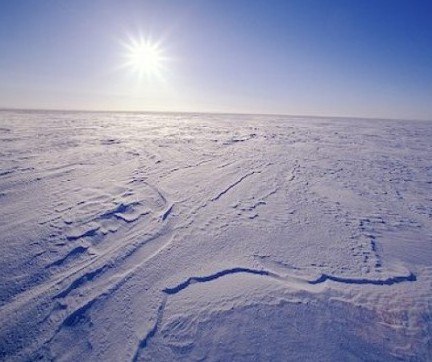
Rock Island, IL
The season of snows was preferred, that I might experience the pleasures of suffering, and the novelty of danger.
—Estwick Evans
Although the sky was clear and pale this morning, I had the sensation as I walked to work that snow was falling. By my guess there are about fourteen inches of snow on the ground already, and the air temperature, according to reports from the airport, is minus twenty-nine Fahrenheit: warm enough for Ivan Denisovich to walk to work and therefore warm enough for me.
I had the sensation that snow was falling because I felt what I thought were snowflakes on my nose and eyelashes, like in the song. But in fact steam was rising from beneath my scarf, lighting on my lashes in the form of little droplets and freezing there. When at last I arrived at my building I resembled one of those insane arctic explorers in the photographs whose eyes are frozen nearly shut by the polar slush.
My legs also felt the cold—at the knees, where my coat stopped. And the tip of my left index finger, which I sliced one morning in sixth grade, attempting to repair a model Chevy I had glued wrong the night before—this, too, registered the cold. It is usually the first to do so. And my feet, of course, felt the cold. But I was otherwise very comfortable. As I walked the streets between my house and my office I saw neighbors and strangers sprinting out to start their cars and warm them up, a practice that is good for the private combustion chamber, no doubt, but bad for the public air.
Keep moving, and an extra layer of wool does just as much good as an already-warm car—and far less harm.
And even now, as my students write in this frigid classroom, the pad of my own hand feels the bite of the cold table-top it rests on. Our room in this old building—the Humanities are always relegated to the oldest buildings—cannot be warmer than fifty-five or sixty.
Many people tell me that I should not walk to work on such days because doing so “isn’t good for you.” When I confess that I sometimes do not eat until dinner time, or sometimes not at all, I am told the same thing. But these gentle reprimands have no purchase on me. Deprivation is good for the soul—and also for the body.
When I climb out of bed at five o’clock in morning and slalom down the stairs to the kitchen to start the coffee, I am firm in my resolve to walk the mile and a half to work, on this frigid morning as on others. I am firm because, for starters, I have given my word on the matter, if only to myself.
And by now this walking has become habitual enough that, if for pressing reasons I do not or cannot walk, I feel that an important part of my day is either missing or has been denied me. I feel, intellectually, the loss of walking the way I would feel, physically, the absence of caffeine, life’s most pleasant addictive substance. Deprived of my walk I am deprived of time to be alone, of time to think, to be reminded that I live in the world regardless of how sedentary and abstract my life might otherwise be—in it rather than over or across it. Without my walk I feel bereft of time and occasion to see the built and natural landscapes at human speed, from man’s eye-view.
But, more fundamentally, I am firm in my resolve to walk the mile and a half because it matters to me that I know both how the cold feels and what it means, neither of which can be known by my walking eight steps into an already warm car, driving a very short distance, and then walking a few dozen steps from my warm car to my (usually) heated building. To know what the cold feels like I must have the chance to be cold, and then the resolve to be cold, for how the cold feels is known by observation, and observation (as John Muir knew well) is impossible without a willing subjection of the self. I must feel the regions of the skin tighten, the mysterious surfaces harden. I must feel the burn of exposed flesh in the stinging wind. I must feel the hardening even of the soles of my boots, which in such weather as this lose their cushion. I must feel the many ways in which life itself becomes hard.
What it means, the cold, is known in part by observation and therefore by subjection and submission. But it is also known by reflection, even as art is known in part by the criticism that completes it. What the cold means is known by memory and by language. We reflect on what we ourselves remember about the cold and about its place in the various narratives of human suffering: the story of a young Elie Wiesel, for example, running through the snow as the eastern front unraveled, or the tale of Ivan Denisovich marching to work on that one good day in his life, or even John Muir’s account of chasing his beloved water ouzel out into the cold and barren snowscape. You cannot expect a warm man to feel the cold, Solzhenitsyn tells us. And he is right. Poor Tom, loose in Lear’s storm, miserable and cold, knows something that Goneril and Regan can never know, for, cold-hearted though they be, they will never willingly be cold.
And for what he knows, for what he is willing by suffering to know, Poor Tom—Edgar in disguise—wins something for himself and for those around him, notwithstanding “the weight of this sad time” he must now obey, or what is grimly implied by Kent’s journey “shortly to go.” When you recollect and reflect upon and articulate the cold, you see at last that the cold is good. In the cold you know you are alive. You see your breath—the breath that Lear looks for as he holds the glass to the lips of the dying Cordelia—and you know that you’re alive. You are alive because you suffer. Patior, ergo sum.
There is no life in Cancun, no life on the beach at Daytona. There no one feels alive—not the way one feels alive in the cold. For it is in the shivering and chattering and goose flesh of the cold that we are nearest the truth of the fragile and desperate human condition. Lovers of snow and cold are qualitatively different from the lovers of sun and surf; they are different moral beings altogether. Our great novelists have been Russian, not Texan; our great composer was an Austrian, not a Californian. No poet named Frost ever wrote a poem titled “Summer.”
It is fitting that we in the Humanities, so insistent that the business of a university is to make humans, should be swept off into the corners of the oldest buildings on our campuses. The knowledge and wisdom we seek and seek to impart do not require falsifying lenses or instruments of torture. We are as austere as monks in our work if we are doing it well. We ask for books and a room in which to talk about them. The computer is of no use to us, really, and the best of us know that the gee-whiz classrooms of the new millennium will produce more Gonerils and Regans than Poor Toms. We must dress warmly for a day in the office, and the students who come to see us there are as wooly as we.
But what ignoble savages we have become, spending our travel money to hear papers that do not feed the hungry or clothe the naked or provide company for the widows and orphans. How unkindly we speak of our colleagues, despite the years of “literature’s civilizing influence.” How quickly we move further and further away from the dark neighborhoods of downtown, despite our protests against sprawl and racial strife. How imperviously we commute in our Volvos all those miles to work to talk about oppression, and then all those miles home again to ignore it.
All the liberal learning in the world, to put things another way, will do nothing for those who refuse to feel the cold, for life is not lived between the covers of books or in the corridors of Founders Hall, whether heated or not. We must live on cold ground, feel the hand of the wind as it slaps us with correctives, look upon food and warmth and refuse them now and again. We must think on Kent and Edgar, Lear and Gloucester, and even on the fool. Certainly Ivan Denisovich tutors us, but he does not make our resolves for us. Solzhenitsyn blessed his own prison years. I once heard a Romanian priest tell of his liberation from eleven years in solitary confinement. He was clutching his bedpost, begging to be left alone. Students do not know enough of these stories, nor do enough of their teachers love them. Too few feel the frost; too few willingly endure its bite.
As for me, God willing, I shall walk through the cold on such northern days as this—that I might be its earnest and deserving pupil. “It is good for me that I have been afflicted,” saith the psalmist. “Henceforth,” said Gloucester, “I’ll bear / Affliction till it do cry out itself / ‘Enough, enough,’ and die.”



22 comments
Jon
Wonderful essay, and also the words of Bob Cheeks. I often cheer my wife on with “embrace the cold!” 🙂
I’ll also offer that, now living in southern NM, a similar experience can be had by being out in the heat of the day. But only for those who choose it…
Emily
I went last night to watch A Prairie Home recorded. Unfortunately, and shamefully, I went to a movie theater to do it. For the first time, some company had persuaded Garrison Keillor to allow his show to be filmed and broadcast live across the country. Lucky me, I guess, for though I live just twenty minutes from the Fitzgerald, there were no seats left. (And I had to go, you see, because it was Elvis Costello, and well, it’s Elvis Costello.) But BECAUSE we went to a movie theater, we were privy to Mr. Keillor’s walking tour of St. Paul, a walk he filmed for just such a nation-wide. . .I believe they used the word ‘cinecast,’ though I doubt that’s what he called it. With an Anoka letter jacket, bare hands, and no hat, he spoke a little bit about the value of cold. He said we Minnesotans are a dark people and like to be reminded. You would have enjoyed it, and it’s probably unnecessary to tell you how comfortable it then was to leave the theater two hours later for the wind and sleet that is Minnesota this week.
But it might be necessary to remind you of that walking tour in Rome. You know, the one with all the rain? And only one of us got to change his clothes before class started? I felt pretty cold then and, I dare say, morally superior to the one who was dry, though only for a moment. He did, after all, walk to get his clothes.
Zach
Try digging ditches in Memphis with the thermometer at 105 and the humidity at 90. That aint too rosy either. And lest you forget, the promise land isnt Alaska.
Good article though, its nice to read about things like this so I don’t have to experience them myself.
Thomas McCullough
I live as a pedestrian in winter much as you describe yourself doing. Possibly you are in a colder place. Mine in coastal Southern New England is much as D.W. Sabin (one whose comments require not so much reading as exegesis) describes his. My observation to you is that you make joyful passages of life sound more like penance. Walking is good, Good.
Bob Cheeks
Sabinski, Smitty’s your palsy…he kinda writes like you…all that business about squids and the boy’s got promise.
But cheroots as insect repellents, my goodness, a reason to imbibe…but no, I say, ere I be tempted, no!
I trust all is well with your technical devices and you are up and composing..your fans await, the grounded metaphor!
We have snow coming in the valley, my wood is stacked by the stove which is certainly the feeling of reassurance shared with a rich Wall Street Republican recently assigned his bonus…ah, yes!
Hans Noeldner
Another good one, Jason! Understanding is all about…visceral.
A snippet from my most recent blog posting, on a related theme:
“So long as well-meaning people remain behind those damned windshields (waiting for third-party “solutions”), they will not learn the first thing about what we-the-people collectively must do to create…not “walkable communities”…but “communities that walk”; communities that bike; and communities that have enough of us walking and biking to make transit viable.”
http://entropicjournal.blogspot.com/2010/02/communities-that-walk.html
D.W. Sabin
I would like to start a collection to finance the hunting down and arse-kicking of Cheeks friend Smitty. Youth are impetuous we know but impetuosity wed to poor judgement in the face of a windfall is just bad form.
The problem with this here aborning Banana Republic is that it aint warm enough over half of it to raise a damned Crepe Myrtle, let alone a tasty banana. Case in point to JS Bangs refutation…them poets he cited come from salubrious Banana Republics. The best we will be able to hope for is a dark homily on excessive household vermin, skittering and nibbling away on the welted skin of lengthy shut-ins.
But, here in southern New England, it is cold but we don’t even get much snow dammit. Shoveling 2″ of snow off a 200′ driveway is an act of self-damnating amateurism. However, around two weeks from now , the Red Maple Buds will start to bulge and the willows and Red Osier dogwood will color the bottoms with their faintly awakening branches and then…well then, March will come knocking with some sunny 50 degree days and the mauve on the hillsides will deepen and in another month and a half, the biggest damned show of exploding biomass and life on this sordid planet will bust out like a Symphony …just before the chewing black flies take a big bite out of the revery. Even cold-weather Banana Republics can have Cheroots, Connecticut wrapped, the thinking man’s insect spray.
I like winter…the rocks show on the tough terrain and I am only thankful that business shall take me to Fort Lauderdale right about the time I am ready to give up.
After all, cold to hot it is ipsum esse….IPSUM ESSE my friends…the great simple beauty of it all. Nature does complexity with simple beauty…too bad we real smart humans caint seem to get the hang of it.
Michael Trees
I’ve long followed your posts on FPR Mr. Peters and have always found them very thought provoking and humorous. I’m not much of a commenter but I thought you might find it entertaining that I read this post not three hours after I’d posted a piece on the tragedy of ethanol as a grain consumer and then told the starving people in the third world to bugger off cause it was 20 degrees out with a foot of snow on the ground and I was going to drive to work. It’s as if you’d plumbed the dark places of my soul and hung out my dirty laundry. Thanks. I’m deeply grateful and terribly peeved. Now I have to walk to work tomorrow.
Fabius
Flannery O’Connor, Walker Percy…
JS Bangs
Addendum: And Faulkner. One mustn’t ever forget Faulkner.
JS Bangs
Our great novelists have been Russian, not Texan; our great composer was an Austrian, not a Californian. No poet named Frost ever wrote a poem titled “Summer.”
I know this is hyperbole, but… really? Do you really expect me to believe that, even if jest? Because I immediately think of Jorge Luis Borges, Gabriel García Márquez, Umberto Eco, and Chinua Achebe, to say nothing of Dante, Homer, and the Psalmist!
Aside from that, I loved the article.
Peter B. Nelson
Thank you, Mr. Peters (or is it Professor Peters?).
Before I was self-employed I, too, numbered among the ranks of the elite walk-to-work corps. And in a prior job I bicycled a few miles. We are different than regular people.
The Minnesota winter of 2009/10 is shaping up to be the coldest and snowiest since my childhood in the 70’s, and with every fresh snowfall I rejoice. In my time in California I found the air stale and the weather boring, but you won’t hear me rhapsodize over the character building hardship of Minnesota’s mosquitoes: Exhibit A in the fallen world hypothesis.
Speaking of walking, I’m just to the end of Charles Frazier’s Cold Mountain. It has a lot of walking. It’s surprisingly good.
Bob Cheeks
I know Ivan Denisovich, Peters, …but you may be someday!
Cold…I remember the cold at 4:30 AM on my way through the environs of Irishtown to serve 5 AM mass for the pottery workers, when the only sound was the crunch of my buckled boots against the snow and me talking to God and Him to me.
Cold…I remember my old man’s stories of the Bulge, the winter of 44/45 when the temperature dropped to fifty below and my old man’s defusing land mines and buried ordinance and finding chickens for his platoon to eat.
Cold…when I broke through the ice on a flooded creek feeding into the frozen Ohio River and my pal, Smitty, who followed my body under the ice being pulled by the current, and had the insight to pick up a tree branch and when I finally broke through to lay it by and holler, “Hold on, Cheeks!” And I did, out of fear, , I held on with one frozen hand and Smitty saved me.
Cold…in the midst of our woods, with the trees glazed in hoarfrost and the spring frozen hard until March. The silence is pure and so is life and I talk to God and He to me.
Tom G.
Jason,
Thanks for the reflections on the cold. As a Upstate New Yorker, and now a Minnesotan, I have always felt the necessity of cold much like the necessity of repentance. Northern winters are a reminder that we are feeble beings at the mercy of elements far beyond our control. In this era of technocracy, and hubris, it is little wonder we shun the cold for it reminds us of our powerlessness. Cold forces us to either despair, or accept our humanity. There is no middle ground.
Owen
As a native southerner who moved North several years ago in part to feel the cold, I still enjoy the bright, life-stoking aspects of real cold that Mr. Peters describes, but I’ve turned against that sort of climate because of the season that follows deep winter. To me, the long, gray, soggy March and April of the North are a cruel joke after having experienced years of glorious, leisurely Southern springs.
I would love to live somewhere with a real winter followed by a beautiful spring, but I don’t think such a place exists.
AML
I just finished making quite a nice snowman here in DC. This has been a unique winter in the Capitol with much more snow and cold than winters past.
There will probably be a delay or cancellation of classes at the university tomorrow, as anything but the lightest dusting creates havoc in this town.
I agree a nice wool coat, scarf, and gloves on over a wool sweater is plenty to keep one warm for a walk.
Comments are closed.