
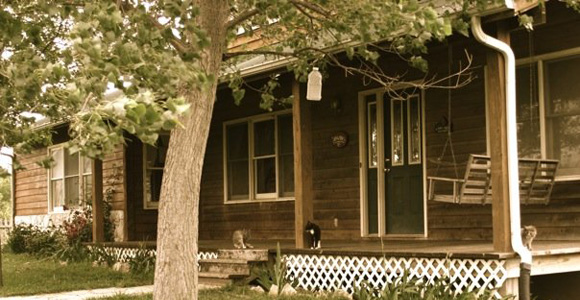

ALEXANDRIA, VA. Names are important, and few can be more significant than what a new publication calls itself. Perhaps at first greeting the name will give pause, causing the new reader to think momentarily about what it means, how it came about, what its creators intended. After a time its explicit meaning will fade into the backdrop, becoming a label that is rarely reflected upon, barely registered, but still confers meaning – increasingly implicit – for the undertaking, and for those who originally named it, or who write under its banner. A name such as this one – Front Porch Republic – deserves some reflection before it fades into that subconscious space.
I can think of no better text by which to explore the meaning of our publication’s name than an old essay – one few have encountered and even fewer still would remember – that I read during my freshman year of college in a course taught by the man who became my mentor and dearest companion still, though he has passed from this vale – Wilson Carey McWilliams. I’ve never forgotten the essay – it impacted me then, and remains with me still. It was written by a man named Richard Thomas, and was entitled “From Porch to Patio.” (Published in The Palimpsest, journal of the Iowa State Historical Society, in 1975). It had such an effect on me not only because of what it taught me, but because so much of my childhood and young adulthood had involved being in various ways on our big front porch where I grew up in Windsor, CT. It was more than merely theory – it taught me about who I was, and why that was so.
In this simple but profound essay, Thomas explores the social implications of the architectural practice of building porches on the front of homes and its eventual abandonment in favor of patios behind the house (I’ve discussed this transition in relation to the film “It’s a Wonderful Life” in comparing Bedford Falls to Bailey Park). As with any central feature in our built environment, this is more than merely a passing fashion trend or a meaningless design change: the transition from porch to patio was one of the clearest and significant manifestations the physical change from a society concerned with the relationship of private and public things – in the Latin, res publica – to one of increasing privacy. The porch, as a physical bridge between the private realm of the house and the public domain of the street and sidewalk, was the literal intermediate space between two worlds that have been increasingly separated in our time, and hence increasingly ungoverned in both forms.
Thomas expresses clearly some of the social dimensions of the porch, and contrasts them with the patio. The porch, he wrote, “presented opportunities for social intercourse at several levels.”
When a family member was on the porch it was possible to invite the passerby to stop and come onto the porch for extended conversation. The person on the porch was very much in control of this interaction, as the porch was seen as an extension of the living quarters of the family. Often, a hedge or fence separated the porch from the street or board sidewalk, providing a physical barrier for privacy, yet low enough to permit conversation. The porch served many important social functions in addition to advertising the availability of its inhabitants. A well-shaded porch provided a cool place in the heat of the day for the women to enjoy a rest from household chores. They could exchange gossip or share problems without having to arrange a “neighborhood coffee” or a “bridge party.” The porch also provided a courting space within earshot of protective parents [for more on this important aspect, see Beth Bailey’s From Front Porch to Back Seat: Courtship in Twentieth Century America]. A boy and a girl could be close on a porch swing, yet still observed, and many a proposal of marriage was made on a porch swing. Older persons derived great pleasure from sitting on the porch, watching the world go by, or seeing the neighborhood children at play.
By contrast, the patio reflected both new settlement patterns and the increasing desire for privacy and withdrawal from interaction with one’s neighbors. “In communities with high rates of mobility, one did not often want to know his neighbor. The constant turn-over of neighbors worked against the long-term relationships which are essential to a sense of belonging.” The patio, it was believed, was a symbol and practical expression of our independence, our liberation from the niggling demands of neighbor and community. Yet, Thomas insightfully notes that it was just as much a symbol and reality of a new kind of bondage, the bondage especially to the automobile and to the grim necessities of mobility, including long commutes and increasing isolation from a wide variety of bonds. It was too soon, perhaps, to note that this form of living also symbolized our increasing bondage to “foreign oil,” though at the time he wrote it America had just recently passed the apogee of oil production and would forever become dependent on foreign powers for our purported liberation through energy – particularly tyrants – eventually fighting a series of wars in a region far from where we should have any real concerns. The house, he wryly noted, housed fewer people but more cars, and it was our new inanimate occupant that “both freed us and enslaved us.”
In a microcosm, the forces that led to the decline of the porch as a place of transition between the private and the public realm have eviscerated both those domains of their capacity to educate a citizenry for self-government. The porch – as an intermediate space, even a sphere of “civil society” – was the symbolic and practical place where we learned that there is not, strictly speaking, a total separation between the public and private worlds. Our actions in private are not merely “private,” but have, in toto, profound public implications. The decline of courtship and marriage proposals within earshot of kin, for one instance, has led to ever greater “privatization” of our intimate lives, and a proportionate decline of the societal and public investment in undergirding families and the communities that foster them. Our private actions of driving ever greater distances in our automobiles have fostered devastated landscapes, deep dependence of foreign powers and tract housing devoid of real community. Meanwhile, our “public” world is increasingly shorn of the voices of citizens, wholly attenuated in the decline of the capacity of localities to govern their fates. For me, there is nothing more symbolic of this fact than the rush of Governors to serve the Obama administration, a sad, pathetic revelation that governing a State is less significant for most of our leaders than becoming a functionary in the national bureaucracy. Our States, not to mention our localities, are ever-less a kind of “porch,” that transition from the world of the home to the public realm of community and eventually State and nation. Instead, as wholly “private citizens” – or, to invoke the preferred term, “consumers” – accustomed to houses that are places of private retreat, we see only one public entity of significance – the national State – but find it difficult to see ourselves a part of it. We regard the State as a distant and mysterious entity, occupied either by our team or their team but in either event an organization so vast, complex and dizzying that we regard it as anything but the locus of our practice of shared self-governance. We are daily less a republic because we daily perceive less of what are common or public things – res publica. Without the literal spaces where we come to know what we have in common through speech, habit and memory, we regard politics as a competitive spectator sport and government as a distant imposition – but in any event, anything but self-rule.
Tocqueville already anticipated the forces that would lead simultaneously to the retreat of individuals into a “small circle” of friends and family, on the one hand, and the rise of the “tutelary State” on the other. Tracing the logic of democracy, he foresaw a time when “no man is obliged to put his powers at the disposal of another, and no one has any claim of right to substantial support from his fellow man, [then] each is both independent and weak. These two conditions, which must be neither seen quite separately nor confused, give the citizen of democracy extremely contradictory instincts. He is full of confidence and pride in his independence from his equals, but from time to time his weakness makes him feel the need for some outside help which he cannot expect from any of his fellows, for they are both impotent and cold. In this extremity he naturally turns his eyes toward that huge entity which alone stands out above the universal level of abasement. His needs, and even more his longings, continually put him in mind of that entity, and he ends by regarding it as the sole and necessary support for his individual weakness” (Democracy in America, II.iv.3).
We rarely consider the ways that our built environment – even something so simple as a front porch – constitutes some of the necessary conditions for self-government. Thinking of ourselves in ways that can only be described as simultaneously disembodied (by means of our technology) and wholly embodied (albeit only as monadic individuals), we ignore the way spaces shape us, even prepare us for lives of responsible citizenship, community, and the proprieties of private life. Instead we simultaneously crave a retreat into the purported liberties of the private realm, yet regard the only public entity worthy of our attention to be a distant and inaccessible government. For those who would stand and defend the future of the Republic, a good place to start would be to revive our tradition of building and owning homes with front porches, and to be upon them where we can both see our neighbors and be seen by them, speak and listen to one another, and, above all, be in a place between, but firmly in place.


37 comments
Sonya Stauffer
Where can I find Robert Thomas essay From Porch to Patio?
Daniel Peper
That article was well-thought out, Mr. Deneen. I always wanted to have a front porch on our house; now I now the basis for my longing. Three years ago, I bought two recumbent tricycles, one for my brother, and one for myself. The purpose was to give us an activity we could enjoy together, and give us the benefits of regular exercise. The trikes have given us more than we could have imagined. In a very important way, they have served as our front porch as we tool through the quiet neighborhoods of our town. We have met more of our neighbors in these 3 years of triking than we met in the previous 36 years. We ride twelve inches above the ground, so we are very approachable. There is a young toddler who takes his grandma for a daily walk; when we sees us on our trikes, he is transfixed. More than that, he is happy.
Sean
I had nearly the same revelation about how technology changes our nature when my mom would tell me about how her family (7 kids) would sit out on the front porch in Detroit in the 1950s on hot summer days to stay cool. Everyone on the block would be out there too, and it was fun to feel a part of a community, even if that did not involve direct discussions. Rather, it was enough to just be with the neighborhood, sharing a personal experience. Then air conditioning, and a million other things, changed all of that. Perhaps what we need are more “shared personal experience”. This is the draw of urban farming in the urban slums of Detroit – to get people to “be together”, sharing an experience and hopefully building trust. Great article – Thank you.
Ellen
I think you’re overlooking the fact that these neighborhoods with front porches and houses close together were built before the era of radio, television, and recorded music. We used to live in an older neighborhood exactly as you describe, and would have loved to sit on the porch and read, but it was completely impossible with the noise emanating from the other houses on the block. When these neighborhoods were built, the sound from other houses was limited to conversation, or to the residents themselves playing the piano or otherwise making their own music. It didn’t go on at all hours — because you couldn’t play the piano for more than several hours at a time. And it wasn’t amplified.
Matteo Donadoni
Fantastic idea!
Ciao from Italy
Southern Beau
I was just reading something else along these lines. The writer writes that in the South you will not here someone says “let’s go sit on the porch ” rather you will hear ” let’s porch”. So let’s porch and save this country one porch at a time. Great name by the way for a blog not only catchy but so true.
Back Bencher
I just recently came across the FPR. Led, in a way, by an American Red Tory. Way back in the headstrong days of Secession prior to 911, I found some thoughtful stuff on Individual Secession. I believe it may be possible with FPR’s approach! By rebuilding home, family, community etca
Johnpdunn1946
Our house dates from the 1820’s – before the era of the porch – and fronts right onto the property line. The yard area between our house and the next was unfenced when we bought the house, but we had to fence it to keep our infant daughter safe and to stop a rambunctious dog from running out into the street and getting hit (as happened to one of our dogs before we put the fence up). Eventually we replaced the waist-high fence with a taller 6-foot fence simply because we wanted a bit of privacy from, among other people, a steady flow of tourists walking by the house. But this never stopped us from being friendly with our neighbors or with those walking by whom we might see through the front windows and whom we’d want to invite in.
Dana P
Front porches is a must when buying a home, my husband and I met and lived in the south and our 1st home there was of course a big long porch to sit out on and watch friends and passing Byers. After we moved west to Utah, I made sure we bought a house with a large porch. Where we can sit and watch the sun go down along with all my planters and flowers making it very pleasant to relax after a long day at work, looking out on our lawn.
Joe Murin
Excellent essay.
What struck me first reading through the posts was how many people read the essay in such a literal context of their own current or past home situations. Not many commented on it being a metaphor for the disintegration of community in the US starting after WW II. But, upon contemplation, the post did connect to the essay since they are mostly looking back longingly at a way of life that is gone. Gone and likely never to return. We are entering a brave new world.
Really glad I was able to follow a link to your website.
Jessa Forth
What a wonderful article! I can’t wait to explore the rest of the site – I only wish I had happened upon it sooner (just as a side note, I came here from NYTimes.com). I remember one of my favorite college professors mentioning the seismic shift in the fabric of American public life when activity moved from the front, permeable stoop of the home to the private, enclosed backyard. I have long stored away this comment, but had never heard more about it until I stumbled across this site – and I am thrilled for the extra substantiation and discussion!
My mom has long had what she calls her “porch time” in the evenings. She will pour herself a glass of wine or sip on a cold beer and sit in her Adirondack chair with our family dog laying near her feet. Sometimes she’ll leaf through a magazine or that day’s mail; other times, she’ll just sit and enjoy the approaching dusk and sunset. That “porch time” is sacred to her, and I sense that it is deeply restorative to her soul at the end of a busy, chaotic day. The subtle but constant activity of the neighborhood streets, combined with the occasional chat with a neighbor who is out for a stroll, is somehow life-affirming. (Perhaps it is easier to make continual use of a porch in Denver, where the weather supports it, as opposed to Memphis where I currently live and suffer through oppressive heat & humidity, even late into summer evenings…)
However, we also do a good deal of grilling and outdoor meals on our deck in the backyard. I have long wished we could do this on our front porch – if only to amplify our use of the space (and who doesn’t long to know where that delicious BBQ odor is coming from when it wafts over the neighborhood? There is no telling when the grilling is confined to a private space!). It is our indoor built environment that hampers our full use of our outdoor built environment; by this I mean simply that our kitchen, where the initial prep work happens, is at the rear of the house, flush to the deck. We can’t mindlessly use our front porch for the transitions between meal prep-grilling-eating because it is simply too far from the kitchen. What if architects and home builders were to invert the layout of most contemporary suburban homes and put the center of indoor life (the kitchen) closer to the potential center for outdoor life and community engagement (the porch)? It would create an axis of liveliness within the first reaches of a property, rather than a unnatural and always slightly unsettling dead-space of an unused living room at the front of most houses.
Once again, thank you for the site. I will be returning!
Steve Mouzon
Good points, Robin. The entire neighborhood must be designed right, otherwise one single porch doesn’t matter. Everything about suburbia is designed to discourage walking… from the average lot width to the design speed of the traffic to the public frontage types… I could go on, but you get the picture. As a result, your move-in experience is typical. But they’re not bad people… rather, their physical environment sets the stage for them to act withdrawn and insular. Take the very same people and put them in a neighborhood designed to be walkable and engaging, and they’ll behave like neighbors used to behave. It’s hard to overstate the importance of setting the stage for people to engage.
Robin Collingwood
Prof. Deneen,
If I built a front porch and sat on it, all I’d see is cars driving by or joggers trotting by. Nobody walks in suburbia, save to empty the nether organs of his dog; there’s nothing to walk to. The only way to change this, I suspect, would be to triple the post-tax price of gasoline, for which other good reasons also come to mind.
But that’s just the tip of the iceberg. When my family moved into our house, not one neighbor came to say hello. That was twelve years ago, and we still don’t know half the people living within three houses of us. And raising the gasoline price won’t help this; it’s much worse in Manhattan, where nobody drives anywhere. Community simply is now almost entirely on elective; this seems to be the wage of valuing individual freedom above all else.
Ever wonder how the Mormons keep such strong communities? It’s not their doctrines. It’s their restriction of individual choice of congregation. A Mormon is required to attend the LDS church nearest his residence – any other LDS congregation will boot him out if he starts showing up regularly. In order to change congregations, he must move house. There’s a lesson in that somewhere …
Merry Christmas anyhow!
LIsa
i remember once i am in patio swings, i realize relaxation is needed by our body. yes, we have so many activities to do, it’s important to have time to relax. our body need to relax, in order fot it to work well.
David Porter (aka Boomer in the Pew)
Patrick,
I happened upon this blog today, July 4th, while thinking of my dear, departed grandmother.
We spent hours, upon hours on her front porch. She read me fairy tales as a young child, the milkman would leave his milk, I was spanked with a plastic ukulele, we would eat our hot blueberry pie smothered in homemade vanilla ice cream, and most delightfully of all, listen to my grandmother’s delighted cackle reverberate around the neighborhood, all from this front porch.
Today, we are in our pool/patio area, secluded from our neighbors, and I feel loss not having a front porch in my life.
Thanks for sharing this.
ann
rather too late to be in the dialogue now, but I find it kinda humorous that james ceaser above is referencing, I assume Frost in his comment “And yet, I am also mindful of the sound advice of a New Englander—and that counts because New England is commune friendly—who told us something to the effect that good fences make good neighbors.”
Would that be Mending Wall?
“Something there is that doesn’t love a wall,
That sends the frozen-ground-swell under it,
And spills the upper boulders in the sun,
And makes gaps even two can pass abreast….”
“…He only says, ‘Good fences make good neighbors’.
Spring is the mischief in me, and I wonder
If I could put a notion in his head:
‘Why do they make good neighbors? Isn’t it
Where there are cows?
But here there are no cows.
Before I built a wall I’d ask to know
What I was walling in or walling out,
And to whom I was like to give offence.
Something there is that doesn’t love a wall,
That wants it down.'”
Rob O.
I’ve longed for the days of my childhood when we spent lots of time playing in the front yard and seeing people on their porches.
My wife & I live on a very busy street, so we spend very little time out there. Appropriately, our front yard is fairly small with the house set forward on the lot to make the most of the back yard. We do spend a LOT of time out in the backyard and our newly upgraded Veranda is an incredibly comfortable, relaxing place to be. We often have meals out there with just the three of us but we also hold quite a few BBQs, birthday parties, and all sorts of other large social gatherings there. Yet it is, at the same time, an isolating environment too.
erinpottery
I live in an old neighborhood full of so many different styles of homes, yet almost every one has a front porch. Kids play outside and grown ups are seen outside talking, relaxing and enjoying the view from their porches. Last night as I walked home from the park with my kids I saw a friend on his porch – we stopped to chat and soon enough there was a group of us on the porch (ages ranging from 16-92!) watching the kids run up and down the yard and sidewalk. What I thought would be a few minute visit turned into an hour of no worries or rushing. Until I read this essay just now I did not think about the implications of porches vs. patios and what it means for a community. Thank you for sharing your insight!
Clay Johnson
front porch:patio::front bench seat:bucket seat
but when we’re driving in my malibu,
it’s easy to get right next to you.
i say, “baby, scoot over, please.”
and then she’s right there next to me.
i need you here with me,
not way over in a bucket seat.
i need you to be here with me,
not way over in a bucket seat.
Eric Donavon E
Long Live the Republic
Mike Lanza
Thanks so much for this post and for starting the blog. I’m thrilled to find a kindred spirit working to build “neighborhood social capital.” My blog, called Playborhood.com, is about bringing kids’ play back to neighborhoods. I’m writing a book on this topic as well.
I’m working on something very relevant to front porches in particular – I’m redoing my front yard to make it into a “front yard family room.” The idea is to create a “third place” for my neighborhood.
The idea that a porch is not quite public, not quite private space is very important. Richard Sennett called what we have now “polarized intimacy.” This condition makes getting to know neighbors difficult. To spend time with a neighbor, you need to invite them inside your house, and they have to agree to be sequestered in there for an hour or more. It’s not a casual invitation, and for the neighbor, leaving is difficult. Contrast this with what I envision at our front yard family room. We’d be dining or snacking on our picnic table next to the sidewalk, and a neighbor and kid will walk by. I’d ask the kid if he wants a piece of fruit, and before you know it, the neighbor would be sitting down, talking to us.
I’ll be able to test this hypothesis when the front yard family room is ready within two months.
Finally, I’m also a kindred spirit politically. Thank you so much for articulating this “front porch” point of view. I often feel lost politically when I advocate community because people then assume I’m into all the other lefty stuff. For instance, I shocked some colleagues when I wrote this article recommending that Congress vote “no” on an environmental education bill. I’m also butting heads with my local school because they’re adopting a new math program that’s pro-calculator and anti-mental calculation called “Everyday Math.”
Steve Mouzon
Patrick, I would have sent this off-list had there been an obvious way to contact you directly, but check out this blog post, which references A Republic of Front Porches:
http://www.originalgreen.org/OG/Blog/Entries/2009/3/17_Porches%2C_Walkability%2C_and_Sustainability.html
John Atchley
I built a house that had a great terrace in back. When it burned down, I rebuilt it with a huge front porch, and kept the great terrace in back. Of course I am in the woods so the only interaction I get is with nature. The house is unfinished but I made sure the porch was completed and we live on it in the summer (not literally, but that time may come). There is not a soul who comes to the house who does not love the porch and I will never live without one again. And…we hardly ever use the terrace!
JC
Many newer homes built in denser developments with back decks are in close proximity. Townhouses are similar too. The key is for communities to require walking and biking paths behind these denser developments and the building of local trails and bike paths near to existing homes. Also encourage local and walkable shopping and amenities.
james ceaser
I’ll Take My Stand (For Decks and Patios)
I have nothing constitutionally against front porches in urban neighborhoods. They used to be very frequent, as one can see from certain sections of cities like Washington and Richmond, and they have definitely come back into vogue. Last week, I was conducted on a tour of Harbor town in Memphis by the Rhodes College political theorist Daniel Cullen. It is a famous example of what is called the new urbanism, and many of the homes had a quaint kind of older look, replete with porches. Many of the new homes being within the city limits of Charlottesville (that is in the age when new homes were still being built) have porches and resemble neighborhoods of the pre-war (not the Iraq War) period. Professor Deneen can take some solace in the movement of the new urbanism, which seems very friendly to his idea of a res publica of porches.
And yet, I am also mindful of the sound advice of a New Englander—and that counts because New England is commune friendly—who told us something to the effect that good fences make good neighbors. I take this as kind of an endorsement of decks and patios, where one can take one’s air without having to fraternize too intimately with one’s neighbors. This reflects the old law that while you can pick your friends and spouse, you can’t always pick your neighbors. I have an impressive strand of Leyland Cypresses on my property sealing me hermetically from my neighbors. I like my current neighbors, enough sometimes even to say hello, but I am not confident that this will always be the case. Ever since Jefferson got rid of primogeniture laws in Virginia, property has been changing hands very rapidly.
Two other reflections. The first is that the agrarian movement among conservatives, dating back to Jefferson and continuing with the Southern Agrarians and W. Berry were not front porch folks, as far as I know. They liked their privacy. And even if a farm house has a front porch, you often have no neighbors. That’s the kind of front porch that makes sense to me. The larger point is that the conservative agrarian movement, hostile to much of modern overdone capitalism, should be kept distinct from the republic of front porches.
Which bring me to the second point. There can be a good deal of public participation and civic mindedness without sharing front porches. Front porches may be an ok thing, but to combat what one fellow called “individualism,” it is more important to have opportunities for important civic participation. A front porch does not a citizen make. And in that regard, I have a two cheers for some suburbs. True they honor the patio over the front porch, but many of them still provide opportunities for fairly robust political participation. Suburbs have gotten a bad rap. A private home that is your castle (with a moat and cannon to fend off hostile neighbors) and a public square for participation—that’s my kind of republic.
Walt
I agree that the front porch acted as an excellent transitional space between public and private. Human psyche feels more comforatble with these types of subtle transitions. However, I think that the disappearance of the porch in favor of the patio has more to do with technology and the democratization of America.
Up until WWII, the back of the house was where the kitchen was, where the horses were, where the out-house was, were the trash burning pit was, and all the other smelly, not-so-nice realities of life. It was also (but very importantly) where all servants entered and services were delivered. We forget that the social classes were much more discriminate, and servants (“the help”) did not come through the front door. Likewise, deliveries were made to the kitchen or the back of the house where servants could handle them.
Around mid-century the back yard was freed from the mees. Indoor plumbing became common; clean cars replaced horss; trash was collected by government; and the kitchen became the central focus of the house. Likewise, the distincition between social classes began to erode and society became much more egalitarian in it’s treatment of others.
Just take a look at what has happened to the Living Room since Victorian times! It is the perfect example of how the democratization of society has changes the way we lived. Because of strict social conventions, Victorian houses had front palors and back palors, men’s palors and women’s palors. If you were lucky enough to get past the entry hall, you were invited to the palor, but never to the other (family) parts of the house. The parlor was a place to show the rest of society your riches and social status.
Mid Century America still had the formal living room, but who entered it became less restricted. Today, the living room has become the “great room”, with kitchen, family room, living room, and dining room all in one. Now parties are more likely than not to be centered around the kitchen than a formal space. The change in the living room really exemplifies the changes to social structure over the past century.
Becky
Ah, this makes me miss my last home, which had a front porch. Nothing was better than coming home from work on a summer’s day and seeing my husband already on the porch, with a drink and a book or crossword puzzle. Plus, we could chat with all the passing neighbors and watch the neighborhood kids and dogs go by . . .
We’ve since moved across the country, and no longer have a front porch. We sometimes hang out on our front stoop, but it’s not the same.
maryQ
Beautiful article. Very interesting web site.
I live in Houston, in a neighborhood built in the 50’s. No front porches to peak of, though some, like us, have an extension of the slab big enough for a few lawn chairs. After Hurricane Ike, when the power was out and the neighbors got together to clear the streets, people began sitting on their little front “porches”, having spontaneous front yard barbecues, and getting to know each other. It was a very special time, for those of us that didn’t suffer more than a power outage and a few tree limbs down, Our little “porch” became very important to us as a way to interact with our neighbors, to keep watch over the neighborhood, and to share food, drinks, batteries and stories. I experienced community in a way I haven’t since my childhood in a small town in the late 60’s-early 70’s.
I don’t wish for another hurricane any time soon, but I long for another ten days like the ones following Ike.
polistra
Reminds me of something I hadn’t thought about in a while … My father, who grew up in Depression-era Oklahoma, had a real hatred of porches. He saw them as a sign of rural backwardness, a pure waste of square feet, a hindrance to modern sophistication. Each house he bought was porchless; each had a rear deck or patio. We never used the decks and patios, but they apparently satisfied his need for an upwardly-mobile architectural symbol.
brierrabbit3030
Great article. Building houses close enough to front walk to have porches near enough to talk to people would eliminate a lot of useless lawn area too. Older neighborhoods had their lawn mostly in the back, where the garden, chickens, etc,were put where most self respecting folk knew they belonged. Maybe a house would become something more than a big box to store people in, between work.
Tertius
Lovely new site, Patrick. Glad to have followed the link from Crunchy Con.
Two quick queries:
1. How can all of the built infrastructure of the burbs be redeemed for a more sociable lifestyle? Certainly walkable developments can be built for today’s yuppie “gentry,” but what can be done to encourage the revitalization of all the already-existing burbs?
2. If patios are bad for the Republic, was the peristylium a contributor to the loss of liberty in Rome?
Oskar Chomicki
Dr. Deneen,
You could not be more correct in your assessment. You are articulating what most of our contemporaries would call “cultural” concerns but of course they are eminently political (at least in the classical sense of the term)! Many, if not most, conservatives would dismiss your critique of the modern built environment as mere “personal preference,” probably because they associate opposition to sprawl with political liberalism. What they fail to see is that our cities and towns are not just reflections of our virtues and vices but active influences upon our actual souls. Our houses, streets, and public spaces actually mold our character!
E.D. Kain
Patrick,
Great stuff! I’ve long thought that some tenets of the new urbanist movement (front porches, walkable communities, etc.) could be some of the missing clues to rebuilding a more localized, self-governed nation. Strong communities are not wrought of moral certitude alone, but also made up of aesthetics as well as practical infrastructure. I’ve lived in walkable communities and the suburbs, and I can attest to the difference in my soul in both places. In one I felt as though I were part of the world around me, and even the superficial interactions with my neighbors were acts that infused me with a greater sense of belonging. In the other I felt detached, alone, separate – essentially, far less human…
Thanks…
AAJD
I think I first cottoned onto the importance of porches in Jane Jacobs’ great *Life and Death of Great American Cities*. I’m glad to see that this idea is getting greater discussion, and look forward to more such good ideas on your website.
David
My wife and I are looking at purchasing our first home and have made a porch one of our requirements. Thank you for demonstrating how important they are for a neighborhood.
Robin
The front porch as “an extension of the living quarters of the family”. Perhaps that is why we have given it up: Who wants to live their life in the plain view of others? We might be in a lot less trouble if we did just that. Thank you for your thoughts. Now to add a front porch.
Rebecca
Excellent article! I knew there was a reason I always wanted a large front porch with a swing… : ) Love the Tocqueville quote.
Comments are closed.